


Start with 3 drops for a short beard, 5–8 for a medium beard, and 10–12 for a long one. That single rule covers most men, most mornings. The reason it matters: beard oil works as a skin treatment first, and the right dose absorbs fully in 20–30 minutes. If your beard still feels slick after half an hour, you used too much.
Quick conversion for your dispenser: one pump typically delivers 2–4 drops, and one “whack” of a flip-top cap delivers roughly 1–2 drops, though both vary by bottle design and oil viscosity. When in doubt, count drops directly into your palm before applying.
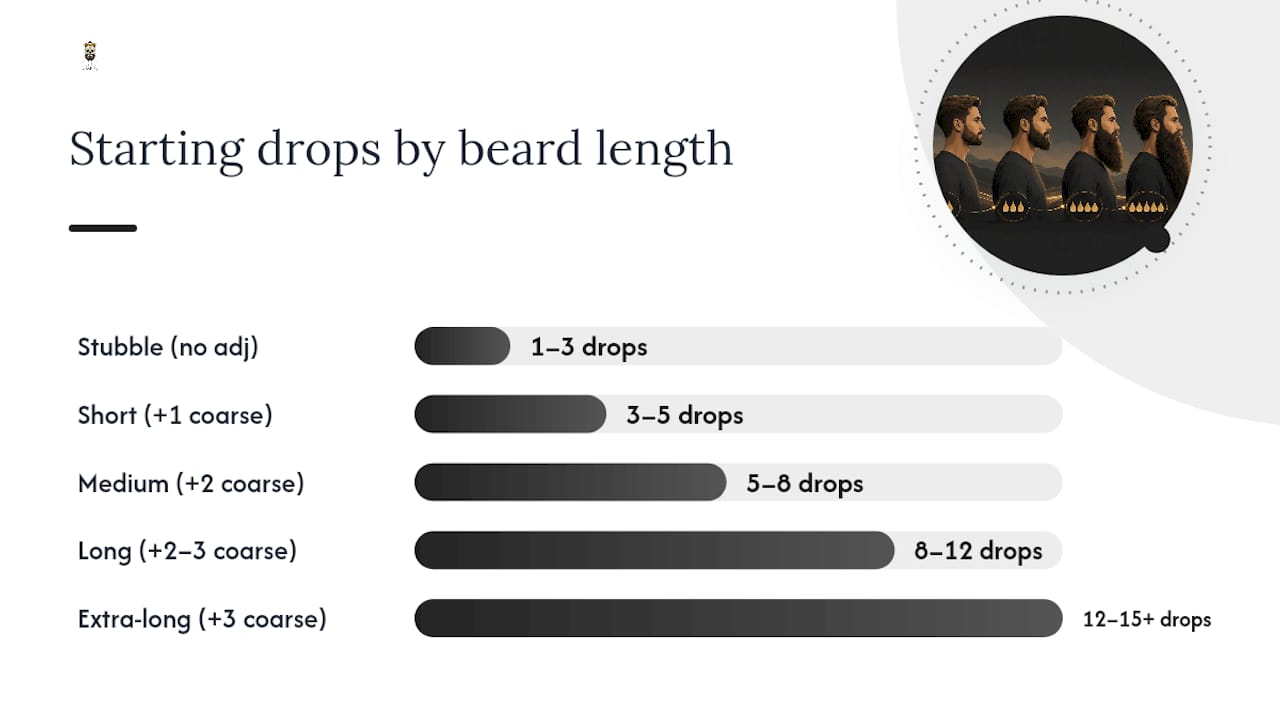
- Stubble (under 1 inch): 1–3 drops
- Short beard (1–2 inches): 3–5 drops
- Medium beard (2–4 inches): 5–8 drops
- Long beard (4–6 inches): 8–12 drops
- Extra-long (6+ inches): 12–15+ drops
Absorption rule: Apply your dose, then wait 20–30 minutes. A correct dose leaves the beard soft and the skin hydrated, with no visible slickness or transfer to your collar.
Key Takeaways
The right beard oil dose absorbs fully into skin and hair within 20–30 minutes, leaving no slickness on the surface and no itch beneath.
| Point | Details |
|---|---|
| Start low by beard length | Use 1–3 drops for stubble, 3–5 for short, 5–8 for medium, 8–12 for long beards. |
| Add one drop at a time | Adjust by a single drop per day until the 20–30 minute absorption check comes back clean. |
| Apply to skin first | Massage oil into the skin beneath the beard before running it through the hair. |
| Damp beard absorbs better | Apply right after a shower for faster absorption and better skin benefit. |
| Ironwoodgrooming formulas | Authentic and Crown beard oils are built for clean absorption at these dose ranges. |
Table of Contents
- How much beard oil do you actually need by beard length?
- How to measure beard oil: drops, pumps, and “whacks”
- When and how often should you apply beard oil?
- Step-by-step application: how to put beard oil on the right way
- Signs you are using too much or too little beard oil
- How long does a bottle of beard oil last?
- Which carrier oils and essential oils work best for your skin?
- The 20–30 minute absorption test: confirm your dose before committing to it
- What most dosing guides get wrong about beard oil
- Ironwoodgrooming beard oils matched to your dosing routine
- Frequently asked questions about beard oil dosing
- Sources
How much beard oil do you actually need by beard length?
Beard length is the fastest way to find your starting dose, but it is not the only variable. Density and hair texture shift the number, sometimes by 2–3 drops.
The table below gives you a working starting point. Both Balm Bench’s dosing chart and Cultured Grooming’s texture-based guide support these ranges, with the consistent advice to start at the low end and add one drop at a time.
| Beard Length | Starting Drops | Texture Adjustment |
|---|---|---|
| Stubble (under 1 in.) | 1–3 drops | No adjustment needed |
| Short (1–2 in.) | 3–5 drops | Add 1 drop for coarse/curly |
| Medium (2–4 in.) | 5–8 drops | Add 2 drops for coarse/curly |
| Long (4–6 in.) | 8–12 drops | Add 2–3 drops for coarse/curly |
| Extra-long (6+ in.) | 12–15+ drops | Add 3 drops; consider a second pass |
Coarse, curly, or coiled beards have more surface area per inch than straight ones. That extra surface area drinks oil faster, which is why a curly medium beard often needs what a straight long beard uses. If your beard is both long and dense, a second brief pass beats loading up with a single large dose. The first round hydrates the skin; the second coats the hair shaft without overwhelming either.
Pro Tip: Start one drop below the chart’s low end on your first try. Add a single drop each morning until the 20–30 minute absorption check comes back clean. You will land on your personal dose in 3–4 days without ever wasting product.
How to measure beard oil: drops, pumps, and “whacks”
The drop count on any chart assumes a standard dropper, but your bottle probably does not deliver a standard drop.
Grams-per-drop is the most precise measurement, but weighing oil on a kitchen scale every morning is not realistic. The practical solution is a one-time calibration test.
How to calibrate your dispenser:
- Hold your bottle over a white surface or a small measuring cup.
- Dispense 10 drops (or 5 pumps, or 5 whacks) at your normal speed and pressure.
- Count the drops that land. If you used a pump or flip-top, count the visible drops in the cup.
- Divide: if 5 pumps produced 12 drops, each pump delivers roughly 2.4 drops.
- Write the result on a sticky note and keep it on your bathroom mirror until the conversion is automatic.
Typical conversions as a starting reference: one standard pump delivers 2–4 drops, and one flip-top whack delivers 1–2 drops. Thicker oils (heavier carrier blends) tend to drop larger, so a viscous formula may deliver your full dose in fewer drops than a lighter one. Always start conservative and let the absorption test confirm the amount, not the dispenser count alone.
When and how often should you apply beard oil?
Daily application suits most men with short to medium beards, especially in dry climates or heated indoor spaces. Long beards often benefit from once-daily use in the morning, with an optional second light application at night if the skin feels tight or the beard looks dull by evening.
Every-other-day use works for men with oily skin, fine hair, or beards under an inch. If your skin produces enough sebum to keep the beard looking healthy between applications, daily oil can tip into over-application territory.
The best moment to apply is right after a shower, while the beard is still slightly damp. Damp hair opens the cuticle slightly, which helps the oil penetrate rather than sit on the surface. Applying to a completely dry beard still works, but absorption is slower and you may need a drop more to get the same effect. If you skip the shower, splash your face with warm water and pat to damp before applying.
Climate and lifestyle shift the frequency. Dry climates, cold wind, and indoor heating all pull moisture from skin faster, so daily use becomes more important. Heavy sweating (workouts, outdoor labor) washes away oil, which means a second application post-workout is reasonable rather than excessive. Humid climates reduce the need, and some men find every other day is plenty from spring through summer.
Timing note: Morning application gives you the most styling benefit. A nighttime application, using 1–2 fewer drops, focuses on skin recovery while you sleep, with no styling pressure.
Step-by-step application: how to put beard oil on the right way
The order matters. Oil applied to the hair first mostly coats the surface. Oil applied to the skin first reaches the follicles, reduces itch, and hydrates the barrier where it counts. Uppercut Deluxe’s application guide makes the same point: skin-first application improves absorption and lets a smaller dose do more work.
- Dispense your dose into one palm. Use the drop count from your calibration test.
- Rub both palms together for 5–10 seconds. Warming the oil thins it slightly and spreads it more evenly.
- Press your palms against your cheeks and neck and massage the oil into the skin beneath the beard. Work in small circles to reach the skin, not just the outer hair.
- Run your fingers through the beard from root to tip, coating the mid-shaft and ends.
- Comb or brush through with a wide-tooth comb or a boar-bristle brush to distribute the oil evenly and remove any tangles.
- Wait 20–30 minutes before putting on a shirt with a collar, or before going to bed if this is a nighttime application.
Pro Tip: If you are applying at night, reduce your dose by 1–2 drops. You are not styling; you are treating the skin. A lighter coat absorbs fully while you sleep and will not transfer to your pillowcase.
For a full morning routine that pairs beard oil with other grooming steps, the Ironwood Morning Grooming Routine walks through the complete sequence.
Signs you are using too much or too little beard oil
Getting the dose wrong is common, and the fix is usually one drop in either direction.
Signs of over-application:
- Beard looks wet or has a heavy shine an hour after application
- Oil transfers to your collar or pillowcase
- Beard attracts lint and dust throughout the day
- Skin under the beard feels clogged or develops small breakouts
If you see any of these, blot the beard lightly with a clean towel, comb through to redistribute, and drop your next dose by 1–2 drops. Over-application does not increase hydration once the skin and hair are saturated. More product just sits on the surface, which is where the greasiness and transfer come from.
Signs of under-application:
- Skin under the beard itches or flakes
- Beard feels rough or tangles easily
- Hair looks dull and dry by mid-morning
- Beard hairs feel brittle at the tips
Add 1 drop to your next application and apply to damp skin rather than dry. If itch and flaking persist after a week of consistent use, the issue may be the formula rather than the dose. Check the ingredient list for potential irritants.
Quick diagnostic after every application:
- 5 minutes post-application: oil should feel absorbed, not pooled
- 20–30 minutes post-application: beard should feel soft, skin should feel hydrated, no visible slickness
- End of day: no transfer, no lint buildup, no tight or itchy skin
Consistent beginner beard mistakes often trace back to dosing, not product quality. Getting the amount right matters more than the brand.
How long does a bottle of beard oil last?
A 1 oz (30 ml) bottle holds roughly 600 drops. A 2 oz bottle holds roughly 1,200. From there, the math is simple.
| Bottle Size | Daily Dose | Uses Per Bottle | Approximate Duration |
|---|---|---|---|
| 1 oz (30 ml) | 3 drops/day | 600 uses | ~6 months |
| 1 oz (30 ml) | 6 drops/day | 300 uses | ~3 months |
| 1 oz (30 ml) | 12 drops/day | 150 uses | ~6 weeks |
| 2 oz (30 ml) | 3 drops/day | 1200 uses | ~12 months |
| 2 oz (30 ml) | 6 drops/day | 600 uses | ~6 months |
| 2 oz (30 ml) | 12 drops/day | 300 uses | ~3 months |
10trim’s bottle lifespan breakdown confirms that cost-per-use for mid-range oils is low even at daily use, which makes a quality formula a better investment than it looks at the shelf price.
Two real-world factors shorten these estimates. First, dispenser waste: pumps and flip-tops lose a small amount to the cap and nozzle each time. Second, heavier formulas (thicker carrier oils) dispense larger drops, so a 6-drop count from a thick oil may deliver more volume than 6 drops from a lightweight one. If your bottle runs out faster than the math suggests, your dispenser is likely delivering larger drops than you think. Run the calibration test from Section 3 to check.
Which carrier oils and essential oils work best for your skin?
The formula inside the bottle matters as much as how much you use. A poorly formulated oil can cause irritation at any dose.
Carrier oils to prefer:
- Jojoba oil: Structurally similar to the skin’s own sebum, which makes it one of the least irritating options for facial skin. Jojoba vs. argan for beards covers the difference in depth.
- Argan oil: Rich in vitamin E and fatty acids; absorbs without a heavy residue. The argan oil skin-first method explains why it works well under the beard.
- Sweet almond oil and grapeseed oil: Lightweight options that suit oily skin or warm climates.
Healthline’s carrier oil overview confirms that jojoba and argan are appropriate bases for facial products and reduce irritation risk when essential oils are diluted into them.
Essential oils: dilution is non-negotiable. Healthline’s essential oil safety guide is direct: essential oils are concentrated plant extracts that can irritate or burn skin if applied undiluted. If a product lists an essential oil as a top ingredient, that is a red flag.
Ingredients commonly linked to irritation: cinnamon bark oil, clove oil, lemon oil (phototoxic), and high concentrations of tea tree oil. Patch-test any new formula on the inside of your wrist for 24 hours before applying to your face.
If you experience recurrent flaking, redness, or persistent itch that does not resolve after adjusting your dose and switching to a gentler formula, consult a dermatologist. Seborrheic dermatitis and contact dermatitis both present similarly to simple dry skin and need different treatment.
The 20–30 minute absorption test: confirm your dose before committing to it
Before you lock in a daily dose, run this test once. It takes half an hour and removes all the guesswork.
- Apply your chosen dose using the step-by-step technique above. Note the exact drop count.
- Set a timer for 20 minutes. Go about your morning.
- At 20 minutes, check the beard surface. Run a clean finger along the outside of the beard. If it comes away with visible oil, the dose is too high. If the skin beneath feels tight or dry, the dose is too low.
- At 30 minutes, check again. A correct dose leaves the beard soft, the skin hydrated, and no slickness on the surface.
- Adjust by one drop in either direction and repeat the next morning. Do not change by more than one drop at a time.
The test works because beard oil splits between two destinations: the skin barrier and the hair shaft. A dose sized correctly for your beard absorbs into both within 20–30 minutes. Anything left on the surface after that window is excess.
Pro Tip: Run the test on a day when you are not going anywhere for the first hour. You want to check the beard in natural light, without rushing, so you can read the result accurately.
Retest whenever you change formulas, switch seasons, or grow your beard into a new length band. A dose that worked for a 2-inch beard will likely be too low for a 4-inch one.
What most dosing guides get wrong about beard oil
Most guides treat beard oil like hair product: more coverage, better result. That framing leads men to over-apply from day one, then blame the formula when their beard looks greasy.
Beard oil is a skin treatment that also conditions hair. The skin beneath the beard is the primary target, and the skin can only absorb so much at once. Once the skin barrier is hydrated and the hair shaft is coated, additional oil has nowhere useful to go. It sits on the surface, transfers to fabric, and attracts debris. That is not a product failure. It is a dosing problem.
The 20–30 minute absorption test exists precisely because feel is a better signal than drop count. Drop counts vary by bottle, by formula, by how cold your bathroom is in the morning. The absorption window does not. A dose that disappears cleanly in 20 minutes is the right dose for your beard, your skin, and your formula, regardless of what the chart says.
The other thing most guides skip: nighttime application is often more effective than morning application for skin health, even though it does nothing for styling. Skin repairs itself overnight. A light dose of a jojoba or argan-based oil applied before bed gives the skin barrier hours to absorb and recover, with no sweat, no UV exposure, and no collar friction working against it. If itch is your main complaint, try shifting your primary application to night for two weeks before changing anything else.
Ironwoodgrooming beard oils matched to your dosing routine
If you have been using whatever oil came in a gift set and wondering why the results are inconsistent, the formula is probably the issue, not your technique.
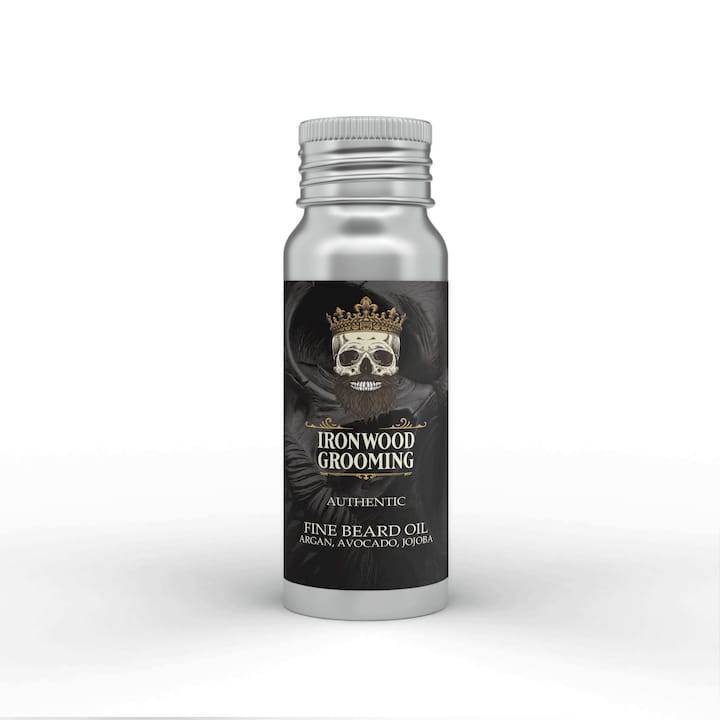
Ironwoodgrooming’s beard oils are small-batch, plant-based blends built around jojoba and argan as the primary carriers, which means they absorb cleanly within the 20–30 minute window at the doses this guide recommends. The Authentic Essential Beard Oil is the right starting point for most men: lightweight enough for daily daytime use at 3–6 drops, and formulated without fillers that slow absorption. For a richer evening application or a thicker beard that needs more hydration per dose, the Crown Beard Oil delivers more per drop without going heavy. A 1 oz bottle at 5 drops daily lasts roughly three months, which makes the cost-per-use lower than most men expect.
Browse the full Ironwoodgrooming beard oil collection to match your beard length and skin type to the right formula.
Frequently asked questions about beard oil dosing
How many drops of beard oil should I use per day? Start with 3–5 drops for a short beard and 5–8 for a medium beard. Adjust by one drop at a time based on the 20–30 minute absorption test.
Should I apply beard oil to a wet or dry beard? Damp is best. Apply right after a shower while the beard is still slightly wet. Dry application works but absorbs more slowly.
Can I use beard oil every day? Yes, for most beard lengths. Men with very short beards or oily skin may find every other day is enough. Daily use is standard for medium to long beards.
What happens if I use too much beard oil? The beard looks greasy, oil transfers to your collar, and the beard attracts lint. Blot with a towel, comb through, and reduce your next dose by 1–2 drops.
How long does a 1 oz bottle of beard oil last? At 6 drops per day, a 1 oz bottle lasts roughly three months. At 3 drops per day, closer to six months.
Is beard oil applied before or after a shower? After. Apply to a clean, slightly damp beard post-shower for the best absorption and skin benefit.
What is the best time to apply beard oil? Morning after your shower for styling benefit. Nighttime with 1–2 fewer drops for skin recovery while you sleep.
Sources
- How Much Beard Oil Should You Use? | Balm Bench
- How to Apply Beard Oil the Right Way (2026) (Perfect Guide)
- Carrier oils | Healthline
- What are essential oils? | Healthline

