


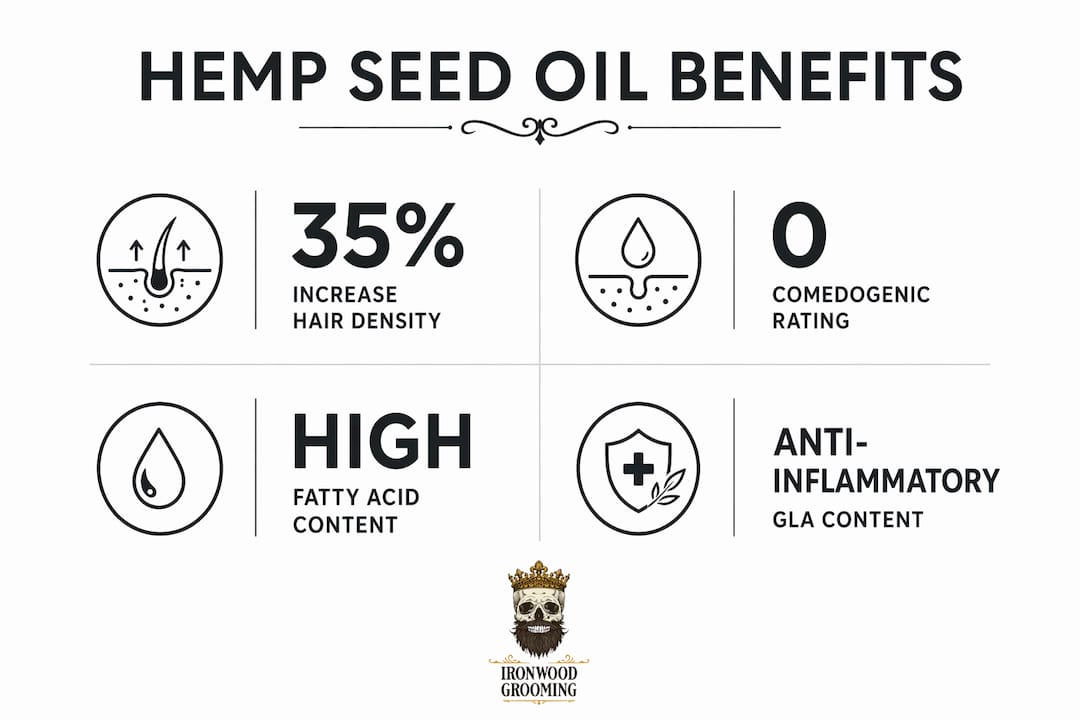
Hemp seed oil is a cold‑pressed carrier oil extracted from Cannabis sativa seeds. It contains no THC and no CBD — the grooming benefits come entirely from its fatty‑acid profile: ~55% linoleic acid (omega‑6), ~15% alpha‑linolenic acid (omega‑3), and 2–4% gamma‑linolenic acid (GLA). That last one is the differentiator. GLA is the reason hemp seed oil calms under‑beard inflammation in a way argan, jojoba, and most other oils simply cannot match.
What GLA Is — And Why It Matters Under a Beard
Gamma‑linolenic acid (GLA) is an omega‑6 fatty acid that almost no common grooming oil contains. Most omega‑6 fats follow the arachidonic‑acid pathway — the route that produces pro‑inflammatory prostaglandins and leukotrienes. GLA takes a different path. It converts to DGLA (dihomo‑gamma‑linolenic acid), which competes with arachidonic acid for the same enzymes and shifts prostaglandin production toward anti‑inflammatory PGE1.
The practical result: GLA reduces the biochemical signals that cause redness, itch, and swelling beneath the beard. This isn’t surface‑level soothing. It’s upstream inflammation control — the kind that matters for men with coarse beards whose skin feels irritated even when no allergen is present.
Argan, jojoba, sweet almond, grapeseed — none of them contain meaningful GLA. Hemp seed oil’s 2–4% GLA is small in absolute terms but massive compared to the near‑zero in most alternatives.
The Full Fatty‑Acid Profile — And What Each Component Does
Hemp seed oil works through three mechanisms at once:
Linoleic acid (~55%) — barrier repair. Linoleic acid is a required building block of ceramide 1 (acylceramide), the lipid that controls transepidermal water loss (TEWL). When sebum is depleted — from overwashing or from coarse beard hair wicking it away — the ceramide layer weakens and the skin becomes dry, flaky, and reactive. Hemp seed oil replenishes linoleic acid directly.
Alpha‑linolenic acid (~15%) — cuticle conditioning. Omega‑3 fatty acids smooth the cuticle surface and reduce inter‑strand friction. They don’t penetrate deeply, but they soften coarse beard hair enough to reduce mechanical irritation on the skin beneath.
Vitamin E — antioxidant protection. Tocopherols stabilize the oil itself and provide antioxidant protection to the skin surface. Outdoors, vitamin E helps buffer UV‑driven oxidative stress on both hair and skin.
Hemp Seed Oil vs. CBD Oil — The Distinction That Matters
Hemp seed oil is pressed from seeds. CBD oil is extracted from flowers and leaves. Hemp seed oil contains no CBD and negligible THC. Its benefits come from fatty acids and vitamin E — not cannabinoids. If you want the skin and beard benefits without any association with CBD products, hemp seed oil is the clean option.
How Hemp Seed Oil Performs Across Beard & Skin Types
| Type | Performance | Best use |
|---|---|---|
| Fine / oily beard | Absorbs quickly; doesn’t weigh strands down | 1–2 drops on damp beard |
| Coarse / thick beard | Softens cuticle; calms irritated skin | 4–6 drops as pre‑wash treatment |
| Sensitive skin | GLA reduces chronic low‑grade inflammation | Daily skin massage post‑wash |
| Dry / flaky skin | Linoleic acid restores ceramide structure | Leave‑in on damp skin |
| Oily / acne‑prone skin | Low comedogenic rating; generally well‑tolerated | 1–2 drops worked into skin |
Hemp seed oil absorbs faster than argan because it contains far less oleic acid (~11% vs. ~43%). Oleic acid is heavy and slow‑absorbing. Linoleic‑dominant oils feel lighter and leave less residue.
How to Use Hemp Seed Oil Correctly
- Pre‑wash treatment. Apply 4–6 drops to dry beard and skin. Leave for 30 minutes. This gives fatty acids time to penetrate before washing.
- Leave‑in on damp beard. After washing, pat until damp. Apply 1–3 drops from root to tip.
- Skin massage. Work a small amount directly into the skin beneath the beard. This is where GLA does its real work.
- Layer with balm. Oil first, balm second. Oil absorbs; balm protects and shapes.
- Adjust frequency. Coarse beards: daily. Fine/oily beards: every other day.
Pro tip: Don’t apply hemp seed oil right before heading out. Give it 10 minutes to absorb — or apply at night.
The most common mistake is using too much. Excess oil sits on the surface, attracts dust, and makes the beard look greasy. Start small.
What the Research Actually Supports
The strongest evidence behind hemp seed oil comes from two mechanisms:
- GLA → DGLA → PGE1 anti‑inflammatory pathway.
- Linoleic acid → ceramide 1 → reduced TEWL.
GLA’s competition with arachidonic acid for cyclooxygenase enzymes is well‑documented in dermatology and inflammatory‑skin research. Topical GLA reduces inflammatory markers in conditions like atopic dermatitis.
Linoleic acid’s role in ceramide structure is equally established. Deficiency increases TEWL — the same pattern seen in men with chronic under‑beard dryness.
A 2026 Food & Function randomized trial confirmed hemp‑derived fatty acids shift plasma fatty‑acid profiles over four weeks. No major cardiometabolic changes were observed. The takeaway: hemp fatty acids integrate into systemic lipid environments, supporting both topical and dietary use.
One limitation: direct beard‑specific studies are limited. The mechanisms transfer logically, but the strongest evidence supports hydration and inflammation control — not accelerated beard growth.
Key Takeaways
| Point | Science |
|---|---|
| GLA is the differentiator | DGLA competes with arachidonic acid → anti‑inflammatory PGE1 |
| Linoleic acid repairs the barrier | Replenishes ceramide 1 → reduces TEWL |
| Low oleic = fast absorption | Less residue than argan or olive |
| Vitamin E protects formula + skin | Chain‑breaking antioxidant |
| Results build over weeks | Barrier repair + inflammation modulation are cumulative |
Why Hemp Seed Oil Is the Most Underrated Oil in Men’s Grooming
Most men reach for argan or jojoba. Solid choices — but neither addresses inflammation at the enzymatic level. Hemp seed oil does. The combination of linoleic acid for barrier repair and GLA for inflammation modulation is rare in a single oil.
The lightweight finish is real. Hemp seed oil absorbs quickly, doesn’t leave a greasy film, and works for daily use without making your beard look wet.
My recommendation: give it three weeks. The changes are cumulative — calmer skin, softer beard, less irritation. Not a surface gloss, but structural improvement.
— Roberto, Ironwood Grooming
Keep Reading
- Argan Oil for Beards: The Skin-First Method That Actually Fixes Itch and Coarseness
- Sebum and Beard Health: What Every Man Should Know
- Beeswax Beard Products: Benefits, Uses, and Results
Part of the Ironwood Regimen Series
New to beard care? Start here.
The Beginner Beard Regimen is the complete start-here guide — cleanse, hydrate, seal — for guys building their first real routine.
See the Beginner Regimen →
