


Most men think beard density is a grooming problem. It isn’t. It’s an androgen biology problem — specifically, how efficiently your skin converts testosterone into dihydrotestosterone (DHT), and how strongly your facial hair follicles respond to that signal. Understanding that pathway doesn’t just explain why your beard looks the way it does. It tells you which interventions can influence density — and which ones never will.
Why DHT — Not Testosterone — Drives Beard Density
Testosterone is the starting point, but DHT is the active signal. Inside the skin, the enzyme 5α‑reductase converts testosterone into DHT. DHT binds more strongly to androgen receptors than testosterone does, and that stronger binding triggers the cascade that produces thicker, longer, more pigmented beard hairs.
This is why two men with identical testosterone levels can have completely different beard densities. The variable is how efficiently their skin converts testosterone to DHT — and how responsive their follicle receptors are. Both factors are genetically determined.
The same pathway behaves differently on the scalp. High DHT sensitivity at the scalp is associated with androgenetic alopecia. Men with dense beards often have higher scalp sensitivity as well — the biology is the same, but the follicle response depends on location.
The Vellus‑to‑Terminal Conversion: What Density Actually Means
Beard density isn’t about follicle count. Most men have roughly the same number of facial follicles. The difference is whether those follicles produce vellus hairs or terminal hairs.
Vellus hairs are fine, short, and lightly pigmented. Terminal hairs are thick, dark, and fully developed. The conversion from vellus to terminal is driven by sustained DHT exposure in follicles with sufficient receptor sensitivity.

This distinction matters. A patchy area with vellus hairs has follicles — they’re just not producing terminal hairs yet. Those follicles can potentially be stimulated. A smooth, truly bald patch with no follicles cannot be stimulated by any topical treatment.
| Hair type | Characteristics | Androgen response | Potential |
|---|---|---|---|
| Vellus | Fine, short, lightly pigmented | Low | May convert to terminal with sustained stimulation |
| Terminal | Thick, pigmented | High | Maintain with grooming |
| No follicle | Smooth skin | None | Topicals ineffective |
What Minoxidil Actually Does — and Why It Works
Minoxidil is the only topical treatment with strong clinical evidence for improving beard density. A randomized controlled trial published in the Journal of Dermatology reported an average increase of ~11 hairs per cm² after 16 weeks of twice‑daily 5% minoxidil.
Minoxidil’s mechanism isn’t fully understood, but research shows it prolongs the anagen (growth) phase, increases follicle size, and supports follicle activity. It doesn’t create new follicles — it activates existing ones that weren’t reaching terminal thickness.
- Apply twice daily to clean, dry skin.
- Expect visible changes at 3–4 months.
- Full results take 12+ months.
- Stopping use gradually reduces gains.
- True bald patches do not respond.
Pro tip: If irritation occurs, reduce to once daily temporarily. Long‑term consistency matters more than perfect early dosing.
Microneedling: The Supporting Mechanism
Microneedling creates controlled micro‑channels in the skin that trigger a wound‑healing response. Research published in the International Journal of Trichology shows microneedling increases growth factor expression (including VEGF) and activates Wnt/β‑catenin signaling — both associated with follicle activation.
Microneedling can complement minoxidil, but timing matters.
Critical rule: never apply minoxidil on the same day as microneedling. Microneedling increases skin permeability, and spacing applications by at least 24 hours helps avoid excessive absorption.
What Lifestyle Actually Does to Androgen Biology
Lifestyle doesn’t override genetics, but it determines whether you reach your genetic ceiling.
- Sleep 7–9 hours. Sleep restriction reduces testosterone availability.
- Manage stress. Chronic cortisol affects the hormonal pathway that supports testosterone production.
- Adequate zinc + protein. Zinc supports 5α‑reductase activity; protein supplies keratin building blocks.
- Exercise regularly. Resistance training supports androgen availability.
- Biotin only helps deficiency. Research shows no benefit in non‑deficient individuals.
The Grooming Layer: Protecting What Biology Produces
Grooming doesn’t change androgen biology — but it protects every terminal hair your follicles produce and maximizes visual density.
- Wash 2–3× weekly with sulfate‑free cleanser.
- Apply beard oil daily to damp skin. Ironwood’s Authentic Essential Beard Oil uses jojoba + argan.
- Brush daily. Trains direction and increases visible fullness.
- Trim regularly. Evens out length and reduces patchy appearance.
- Exfoliate 2–3× weekly. Keeps follicle openings clear.
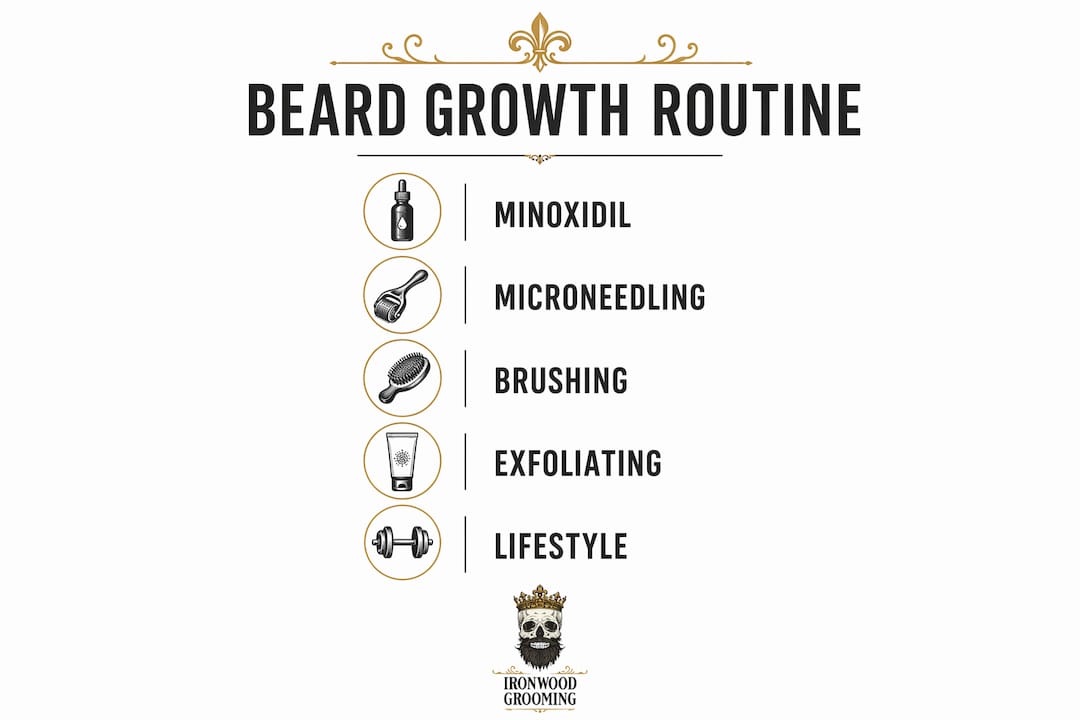
The Full Routine: Biology First, Grooming Second
- Morning: 1 ml 5% minoxidil on clean, dry skin. Wait 4 hours before applying oil.
- Daily brushing: 30–60 seconds.
- Wash 2–3× weekly: Sulfate‑free, fragrance‑free.
- Exfoliate 2–3× weekly: On non‑wash days.
- Microneedling once weekly: Never on minoxidil days.
- Evening: Second minoxidil application.
- Monthly photos: Same lighting, same angle.
Key Takeaways
| Point | Science |
|---|---|
| DHT drives beard density | 5α‑reductase converts testosterone → DHT; DHT binds more strongly |
| Density = vellus → terminal conversion | Follicle count is similar across men |
| Minoxidil is evidence‑supported | RCT shows ~11 hairs/cm² increase at 16 weeks |
| Microneedling amplifies results | VEGF + Wnt pathway activation |
| Sleep + stress affect androgen availability | Hormonal pathways respond to lifestyle |
What I’ve Learned After Years of Watching Men Chase Density
Most men fail not because of genetics — but because they quit too early. The first three months show almost nothing. That’s normal. The biology is working beneath the surface.
The biggest mistake is treating true bald patches with topical treatments. If a spot has no follicles, nothing topical will grow hair there. Accepting that early saves frustration and focuses effort where biology can respond.
The grooming layer matters more than men expect. While you wait for minoxidil to convert vellus hairs, grooming makes your current beard look fuller — which keeps you consistent. Consistency produces results.
— Roberto, Ironwood Grooming
Keep Reading
- Beard Hair Growth Cycle: Anagen, Catagen & Telogen Explained
- Sebum and Beard Health: What Every Man Should Know
- Why Your Beard Needs Daily Brushing: A Coarse Beard Guide
Part of the Ironwood Regimen Series
New to beard care? Start here.
The Beginner Beard Regimen is the complete start-here guide — cleanse, hydrate, seal — for guys building their first real routine.
See the Beginner Regimen →
