


Most men choose a beard balm based on hold strength and scent. Almost none think about the wax that creates that hold — what it’s made of, how its chemistry affects spreadability, heat stability, and skin compatibility, and why the choice of wax matters more for coarse beard hair than any other beard type. The shift from animal‑derived waxes to plant‑based alternatives isn’t just ethical. For coarse, wiry beards, it’s a performance upgrade grounded in the chemistry of how these waxes behave on thick hair shafts and reactive skin.
What Wax Actually Does in a Beard Balm
Wax is the structural backbone of any beard balm. Oils condition. Butters soften. Wax determines everything else — hold strength, spreadability, heat stability, and how the balm interacts with the skin beneath the beard.
All waxes are built from long‑chain esters formed from fatty acids and fatty alcohols. Their ester composition, chain length, and melting point determine how hard the wax is at room temperature, how easily it melts in your hands, how evenly it spreads, and how well it adheres to the hair shaft. These aren’t abstract chemistry details. They directly determine how your beard looks six hours after application.
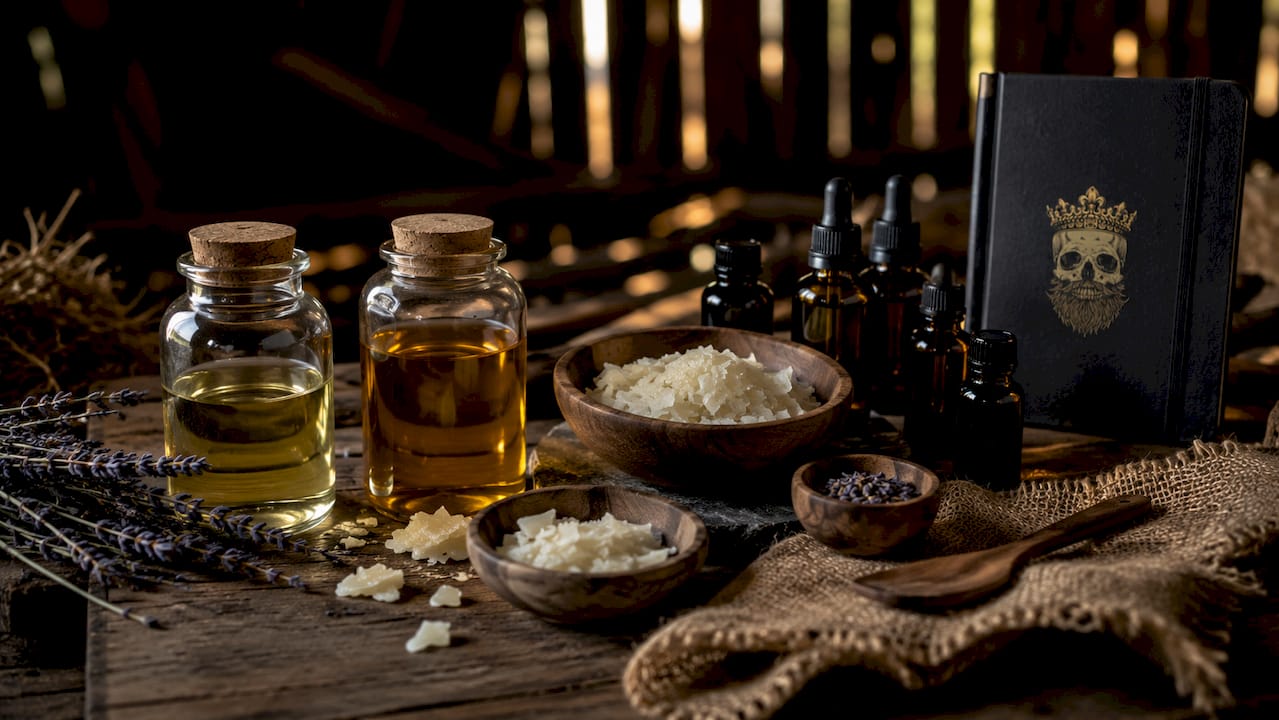
Beeswax: The Baseline
Beeswax has been the default beard‑balm wax for decades. Its composition — roughly 35% monoesters, 14% hydrocarbons, plus diesters and free acids — gives it a melting point around 62–65°C. It softens easily in the hand and spreads reasonably well.
For fine or medium beard hair, beeswax performs adequately. For coarse beard hair, it runs into two limitations:
- Heat stability: Its moderate melting point means beeswax softens quickly in warm conditions, causing hold to fade by midday.
- Allergen risk: Beeswax is a documented contact allergen. Patch‑test studies show sensitization in a subset of users, especially those with reactive or atopic skin.
Lanolin — another traditional animal‑derived ingredient — carries an even higher allergen burden. Dermatology literature consistently identifies lanolin as a common cause of cosmetic contact dermatitis.
Candelilla Wax: Harder, Cleaner, Better for Coarse Hair
Candelilla wax comes from the Euphorbia antisyphilitica shrub native to northern Mexico. Its chemistry is different from beeswax: roughly 50% hydrocarbons, triterpenoids, and a smaller ester fraction. This gives candelilla a higher melting point — about 67–79°C — and a harder texture at room temperature.
For coarse beard hair, that hardness is an advantage. Thick strands resist shaping. A wax with a higher melting point maintains structure through body heat and warm weather, meaning hold lasts longer without reapplication.
Candelilla also spreads more evenly than beeswax. For dense, coarse growth, that spreadability means full coverage with less product — without the heavy, waxy buildup that makes thick beards feel stiff.
The Cosmetic Ingredient Review has assessed candelilla wax as safe for cosmetic use, and it is classified as non‑comedogenic — a meaningful benefit for men with reactive skin beneath a dense beard.
Carnauba Wax: The Hardest Natural Wax
Carnauba wax comes from the leaves of the Copernicia prunifera palm in Brazil. It is the hardest natural wax available, with a melting point of 82–86°C and an ester‑dominant composition (~80% aliphatic esters).
Carnauba provides exceptional firmness and a light natural sheen, but it is too hard to use alone in beard balm. Formulators blend it with candelilla or carrier oils to create a balm that spreads smoothly while delivering firm, heat‑stable hold — ideal for coarse beard hair that needs structure without stiffness.
| Property | Beeswax | Candelilla | Carnauba |
|---|---|---|---|
| Melting point | 62–65°C | 67–79°C | 82–86°C |
| Composition | Monoesters + hydrocarbons | Hydrocarbons + triterpenoids | Aliphatic esters (~80%) |
| Hold strength | Medium | Medium‑firm | Firm (blended) |
| Spreadability | Moderate | High | Low |
| Heat stability | Moderate | Good | Excellent |
| Allergen risk | Moderate | Low | Low |
| Comedogenicity | Low–moderate | Non‑comedogenic | Non‑comedogenic |
| Finish | Matte | Natural matte | Light sheen |
The Carrier Oil Layer: What Conditions While the Wax Holds
Wax provides structure. Oils provide conditioning. For coarse beard hair, three ingredients stand out:
Jojoba: A liquid wax ester structurally similar to human sebum. It integrates with the skin surface without disrupting natural lipids and softens coarse hair without greasiness.
Argan: Rich in oleic and linoleic acids — both components of the skin’s lipid matrix — plus vitamin E. It softens the cuticle and adds natural sheen.
Shea butter: High in stearic and oleic acids, plus triterpenes with documented soothing properties. Ideal for skin irritated by coarse hair friction.
Why Coarse Beard Hair Benefits Most from Plant Wax Chemistry
Coarse beard hair has a thicker shaft and a more raised cuticle. That raised cuticle increases friction, resists shaping, and makes moisture harder to retain. The wax in a balm must adhere strongly enough to hold thick strands in place while spreading evenly through dense growth.
Beeswax’s moderate melting point and spreading behavior make it adequate for fine hair but suboptimal for coarse beards. It can feel heavy, soften too quickly, and trigger irritation in sensitive skin.
Candelilla’s higher melting point and superior spreadability solve those problems. It holds coarse hair through heat and movement, spreads evenly with minimal product, and carries a lower allergen risk.
The practical result: a candelilla‑based balm holds longer, spreads cleaner, and feels lighter — exactly what coarse beard hair needs.
How to Apply Balm for Maximum Performance
- Wash 2–3× weekly with sulfate‑free cleanser.
- Pat dry — leave slight moisture. Residual warmth helps oils distribute.
- Warm a pea‑sized amount fully. Coarse hair requires fully melted wax for even spread.
- Work into the skin first. Conditioning begins at the skin.
- Distribute root to tip. Use a boar bristle brush or wooden comb.
- Apply daily. Consistency builds cumulative softness and control.
Pro tip: Start with less. Coarse hair looks best with light, even application — not heavy buildup.
Key Takeaways
| Point | Chemistry |
|---|---|
| Candelilla outperforms beeswax | Higher melting point = better heat stability + longer hold |
| Carnauba adds structure | Hardest natural wax; blended for firm, workable hold |
| Plant waxes reduce irritation | Beeswax/lanolin = documented allergens; candelilla/carnauba = low risk |
| Jojoba matches skin lipids | ~97% wax esters similar to sebum |
| Shea calms irritation | Triterpenes support comfort beneath coarse hair |
Why I Switched — and What Changed
I used beeswax balms for years. They worked — until midday heat softened the hold and my under‑beard skin stayed irritated. I assumed that was just how coarse beards behaved.
Switching to candelilla changed everything. The hold lasted longer. The balm spread cleaner. And the irritation I had accepted as “normal” disappeared within two weeks. I wasn’t reacting to my beard. I was reacting to beeswax.
The chemistry is simple: coarse hair needs higher melting points, cleaner spreadability, and lower allergen load. Plant waxes deliver all three.
My advice: read the ingredient list before the marketing copy. If candelilla or carnauba is high on the list, you’re looking at a balm built for performance — especially on coarse beard hair.
— Roberto, Ironwood Grooming
Keep Reading
- How to Identify Vegan Beard Products: 2026 Guide
- Vegan Beard Care for Sensitive and Reactive Skin
- Why Beard Hair Grows Wiry: Causes and Real Fixes
Part of the Ironwood Regimen Series
New to beard care? Start here.
The Beginner Beard Regimen is the complete start-here guide — cleanse, hydrate, seal — for guys building their first real routine.
See the Beginner Regimen →
