


Most beard irritation isn’t a beard problem — it’s a skin barrier problem. The skin beneath your beard works the same way as the skin everywhere else on your face. It relies on a thin, lipid‑rich layer called the stratum corneum to hold moisture in and keep irritants out. When that layer breaks down, everything goes wrong at once: itch, redness, flaking, tightness. Understanding how the barrier works — and what specifically disrupts it under a beard — gives you a framework that makes every grooming decision clearer.
This is the science behind why sensitive skin reacts, and the evidence‑supported routine for rebuilding it.
What the Skin Barrier Actually Is
The skin barrier is a structured lipid matrix within the outermost layer of the skin — the stratum corneum — composed of ceramides, free fatty acids, and cholesterol. These lipids fill the spaces between skin cells and form a semi‑permeable seal that controls two things: how much water escapes through the skin surface (transepidermal water loss, or TEWL) and how much of the external environment gets in.
When the barrier is intact, TEWL stays low, skin feels comfortable, and the immune system beneath the surface stays calm. When the barrier is compromised — through harsh surfactants, sebum depletion, or mechanical friction — TEWL rises, the skin dries out, and inflammatory signals activate. That sequence sits behind most cases of beard itch, redness, and flaking that don’t have an obvious external cause.
Ceramides make up the largest fraction of the barrier and provide most of its structural integrity. Research shows that ceramide depletion is common in reactive skin — the barrier becomes thinner and more permeable. Free fatty acids help maintain the skin’s slightly acidic pH, which supports the enzymes that produce new ceramides. Cholesterol contributes to barrier flexibility and repair speed. Disrupt any one of these components and the entire system becomes less effective.
How a Beard Specifically Disrupts the Skin Barrier
A beard creates a microenvironment on the face that doesn’t exist anywhere else. It traps heat and humidity, alters airflow, and — critically — redistributes sebum away from the skin surface and along the hair shaft. Sebum isn’t just a moisturizer. It carries free fatty acids and lipids the skin uses to maintain the barrier. When beard hair pulls sebum away faster than the skin can replace it, the barrier becomes lipid‑depleted and TEWL rises.
This is why men with coarse, dense beards often experience more dryness and irritation beneath the beard — more hair surface area means more sebum redistribution.
The second mechanism is surfactant exposure. Research on sodium lauryl sulfate (SLS) — a common surfactant in shampoos and face washes — shows that it increases TEWL, disrupts the lipid matrix, and raises skin pH. A higher pH impairs the enzyme systems involved in barrier repair. Daily SLS exposure on already lipid‑depleted skin compounds irritation and slows recovery.
| Barrier disruption | Cause under a beard | Effect |
|---|---|---|
| Sebum redistribution | Hair pulls lipids away from skin | Elevated TEWL, dryness |
| Surfactant exposure | SLS-containing cleansers | Raised pH, impaired repair |
| Mechanical friction | Rubbing, harsh brushing | Stratum corneum disruption |
| Allergen penetration | Fragrance, essential oils | Immune activation |
| Thermal stress | Hot water, trapped heat | Increased TEWL |
Why Fragrance Is the Highest‑Risk Ingredient for Reactive Skin
A compromised barrier is more permeable. Ingredients that would sit harmlessly on intact skin can penetrate deeper and trigger immune responses. Fragrance is the most common cosmetic trigger for contact dermatitis.
The mechanism is sensitization: repeated exposure to a fragrance allergen through a compromised barrier can train the immune system to react to it long‑term. Once sensitized, even small amounts can trigger irritation. This is why men with reactive skin often find fragranced beard oils worsening their symptoms over time.
Essential oils — tea tree, cinnamon, peppermint, eucalyptus — contain concentrated fragrance compounds. They aren’t inherently harmful on healthy skin, but on a compromised barrier they carry a meaningful sensitization risk.
Practical rule: fragrance‑free formulas only until the barrier is fully restored.
What the Science Says About Barrier Repair
Barrier repair is an active biological process. The skin synthesizes new ceramides, fatty acids, and cholesterol in response to disruption — but that synthesis takes time. Research shows that full restoration of a significantly disrupted barrier takes three to four weeks of consistent, low‑intervention care.
Repair is supported by hydration, gentle cleansing, and lipid replenishment. Repair is slowed by surfactants, frequent product changes, and mechanical friction.
This is the scientific basis for the four‑week consistency rule.
The Evidence‑Supported Routine for Barrier Repair Under a Beard
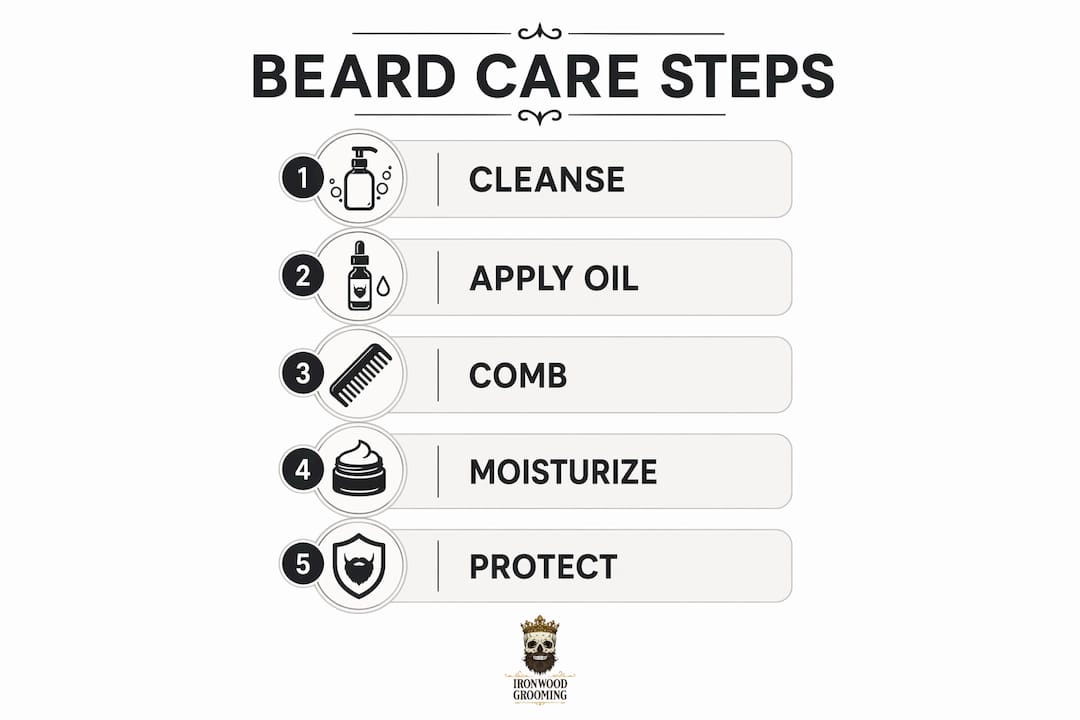
- Wash 2–3× weekly with a sulfate‑free, fragrance‑free cleanser. Eliminating daily SLS exposure removes a major source of barrier disruption. On non‑wash days, use lukewarm water only. Ironwood’s Ultra Soft Beard Wash is formulated for this exact need.
- Apply beard oil to damp skin immediately after washing. Residual moisture helps oils spread evenly and supports comfort while the barrier repairs. Work the oil into the skin beneath the beard — that’s where the barrier lives.
- Choose sebum‑compatible oils. - Jojoba: structurally similar to human sebum - Argan: provides oleic + linoleic fatty acids - Grapeseed: lightweight and non‑comedogenic These three are the most compatible with compromised skin.
- Use gentle tools only. Soft boar bristle brushes and wide‑tooth wooden combs distribute oil without friction. Avoid fine‑tooth metal combs and stiff synthetic brushes.
- Pat dry — never rub. Rubbing disrupts the stratum corneum. Patting preserves the lipid matrix.
- Hold the routine for four weeks. Barrier repair takes time. Every product change introduces new variables.
Pro tip: Winter dryness accelerates TEWL. Add a fragrance‑free beard butter if needed. In summer, scale back.
When to Use Medicated Treatment
If redness, persistent itch, or flaking doesn’t improve after two weeks of gentle care, dermatologists commonly recommend short‑term use of 1% hydrocortisone. Use only as directed by a clinician.
Note: Prolonged steroid use can thin the skin. Hydrocortisone is a short‑term bridge — not a long‑term solution.
If flaking is greasy or yellowish with redness, clinical research supports antifungal shampoos (ketoconazole 1–2%) for seborrheic dermatitis. Leave on for 3–5 minutes before rinsing.
Key Takeaways
| Point | Science |
|---|---|
| Wash 2–3× weekly | SLS raises pH and disrupts lipids |
| Apply oil to damp skin | Supports comfort while barrier repairs |
| Choose jojoba, argan, grapeseed | Sebum‑compatible lipid profiles |
| Avoid fragrance | Fragrance is the top cosmetic allergen |
| Hold routine for 4 weeks | Barrier repair is a biological timeline |
Why the Science Points to Less, Not More
The mistake men make is treating a barrier problem like a product deficiency. They add more products, more botanicals, more steps — each one introducing new irritants to a barrier that’s already too permeable.
The biology says otherwise. A compromised barrier needs fewer variables, not more. Remove the disruptors. Supply the lipids. Hold the routine. Let the skin repair itself.
I’ve seen men resolve years of irritation by switching to a single jojoba‑based oil, reducing wash frequency, and giving their skin four uninterrupted weeks. No medicated creams. No complex routines. Just consistency.
Ironwood formulates around this principle — clean ingredients, small batches, no fillers. It’s not a marketing angle. It’s the correct approach for reactive skin.
— Roberto, Ironwood Grooming
- Vegan Beard Care for Sensitive and Reactive Skin
- Switch to Hypoallergenic Beard Products for Coarse Skin
- Coarse Beard Grooming Routine Explained
Ironwood Regimen Series
The Minimalist Regimen — Built for Sensitive Skin
A step-by-step routine designed for reactive skin — fewer ingredients, less intervention, real results.
See the Minimalist Regimen →
