


Daily beard brushing is one of the most mechanically effective grooming habits available to men with coarse facial hair. It physically redistributes sebum along the hair shaft, removes corneocyte buildup from the skin surface, and applies directional mechanical force to hairs that are still in the anagen (active growth) phase. This guide covers the biology behind each benefit, the correct technique, and the tools that are actually suited to coarse hair.
The Biology of Coarse Beard Hair
Coarse beard hair differs from fine hair in measurable ways. The hair shaft diameter of terminal beard hair is significantly larger than vellus or scalp hair — typically 60–120 micrometers in diameter compared to 40–60 micrometers for fine hair. This larger diameter means a greater surface area to cover with sebum, a higher resistance to lying flat due to increased stiffness (governed by the hair's second moment of area, which scales with the fourth power of radius), and a cuticle layer that is more prone to mechanical lifting when dry.
The sebaceous glands attached to beard follicles produce a fixed daily volume of sebum regardless of beard length. As beard length increases, that fixed volume must coat a proportionally larger surface area — a phenomenon sometimes called the wick effect, where the hair shaft draws sebum away from the skin surface toward the tips. The result is dry skin beneath the beard and dry, brittle hair tips, even when the roots appear oily. Mechanical distribution via brushing directly addresses this imbalance.
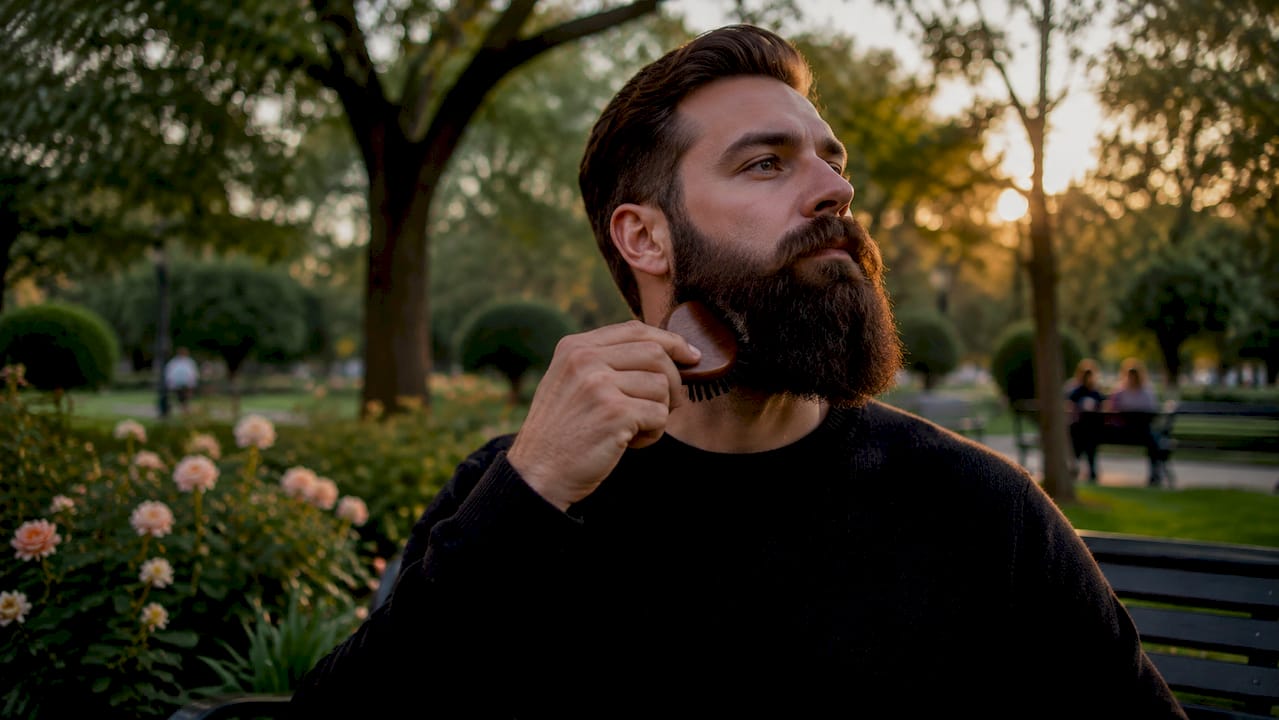
What Brushing Actually Does: The Mechanisms
1. Sebum Redistribution
Boar bristle brushes are composed of natural keratin fibers with a scaled surface structure that is microscopically similar to the cuticle of human hair. This surface texture allows the bristles to absorb lipids (sebum and applied oils) at the root zone and deposit them along the mid-shaft and tips as the brush passes through the beard. This is a passive capillary and adsorption process — the bristle surface picks up lipid molecules and transfers them through mechanical contact with the hair shaft.
Synthetic nylon bristles and plastic combs do not replicate this. Their smooth, non-porous surfaces do not adsorb sebum. They move hair mechanically but do not redistribute lipids. For coarse beards — where the sebum deficit at the tips is most pronounced — this distinction is functionally significant.
What the evidence supports: The wick effect and sebum distribution deficit in longer hair is well-documented in dermatological literature. The lipid-adsorbing properties of natural keratin bristles are established in cosmetic science. The claim that brushing improves sebum distribution along the shaft is mechanistically sound.
2. Mechanical Exfoliation of the Stratum Corneum
The outermost layer of skin — the stratum corneum — is composed of dead, flattened keratinocytes (corneocytes) that shed continuously through a process called desquamation. Under a dense beard, airflow is reduced and washing products often fail to reach the skin surface, slowing the natural shedding of corneocytes. Accumulated corneocytes contribute to the flaking commonly called beardruff.
Brush bristles physically dislodge loosely adherent corneocytes from the skin surface — a form of mechanical exfoliation. This is the same principle behind facial exfoliation brushes used in dermatology. The effect is most pronounced when the brush reaches the skin surface, which requires applying sufficient pressure to penetrate the beard to the skin level.
What the evidence supports: Mechanical exfoliation of the stratum corneum is well-established. The claim that brushing reduces beardruff through corneocyte removal is mechanistically sound. Note: if beardruff is caused by Malassezia yeast overgrowth (seborrheic dermatitis) rather than simple corneocyte accumulation, brushing alone will not resolve it — antifungal treatment is required. See Sebum and Beard Health for the full breakdown.
3. Increased Local Microcirculation
Mechanical stimulation of the skin surface increases local blood flow through a neurogenic and mechanical vasodilation response. The dermal papilla — the vascular structure at the base of each hair follicle — is fed by a capillary loop. Increased microcirculation delivers more oxygen and nutrients to the matrix cells responsible for hair shaft production during the anagen phase.
A 2016 study by Koyama et al. (ePlasty, 16, e8) demonstrated that standardized scalp massage — a form of mechanical stimulation — increased hair thickness and upregulated genes associated with hair growth in the dermal papilla. While this study was conducted on scalp hair, the follicular anatomy and vascular supply are conserved across body sites. The mechanistic pathway is applicable to beard follicles.
What the evidence supports: Mechanical stimulation increases local microcirculation — this is established physiology. The Koyama et al. study provides direct evidence for mechanical stimulation increasing dermal papilla gene expression associated with hair growth. Extrapolation to beard follicles is mechanistically reasonable but not directly studied in beard-specific trials.
4. Directional Mechanical Force on the Hair Shaft
Hair direction is determined by the angle of the follicle in the dermis and the direction of the hair's exit from the follicle canal. Follicle angle is fixed — brushing does not change the follicle's orientation. What brushing does is apply consistent mechanical force to the hair shaft above the skin surface, training the portion of the hair that has already emerged to lie in a preferred direction.
This is analogous to the way repeated bending of a wire creates a preferred curvature — the hair shaft, being a viscoelastic material, responds to repeated directional stress by adopting a preferred orientation over time. The effect is temporary and requires consistent repetition to maintain, because new hair growth from the follicle will emerge at the follicle's natural angle.
What the evidence supports: The viscoelastic properties of hair and its response to mechanical stress are established in materials science and cosmetic chemistry. The claim that brushing "trains" hair direction is accurate in the sense of mechanical conditioning of the emerged shaft — not in the sense of altering follicle angle or growth direction at the biological level.
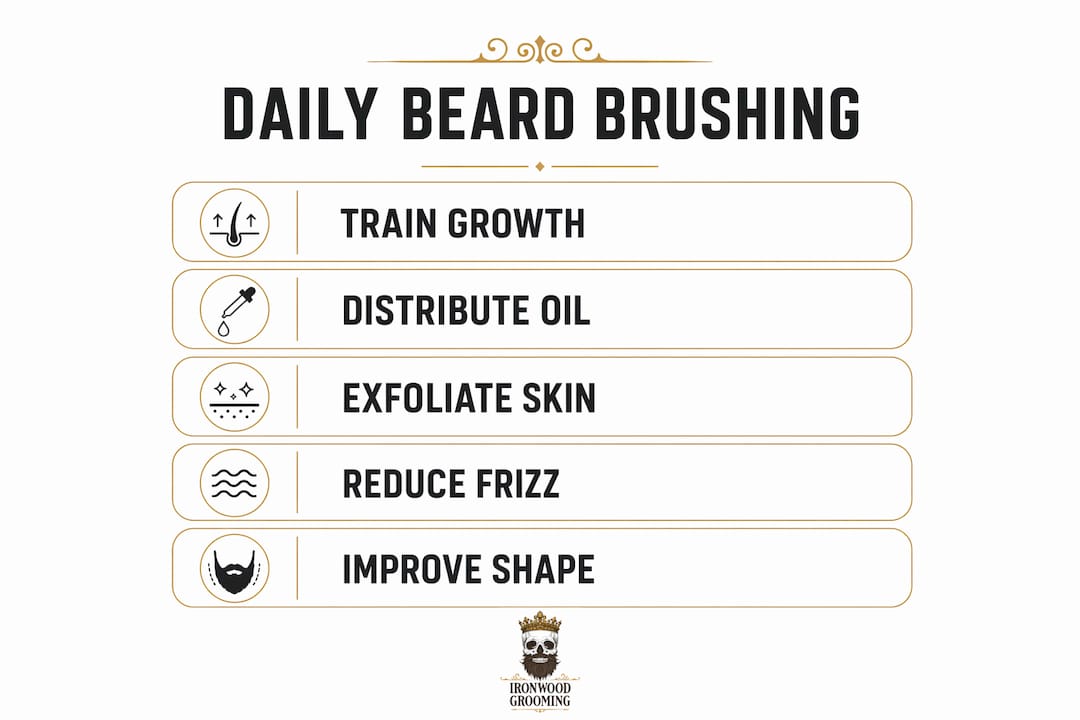
Boar Bristle vs. Synthetic: What the Difference Actually Is
| Property | Boar bristle brush | Synthetic / plastic comb |
|---|---|---|
| Surface structure | Scaled keratin — adsorbs lipids | Smooth polymer — does not adsorb lipids |
| Sebum redistribution | Yes — passive capillary transfer | No — moves hair only |
| Static charge | Low — keratin is a poor triboelectric material | Higher — nylon and plastic generate static |
| Skin exfoliation | Yes — bristles reach skin surface | Minimal — teeth don't contact skin |
| Detangling | Limited — not suited to tangled long beards | Effective — wide-tooth combs excel here |
| Best application | Sebum distribution, exfoliation, shaping | Detangling, length styling, precision work |
The anti-static property of boar bristle is relevant to coarse beards specifically. Coarse hair has a larger surface area and is more prone to triboelectric charging from plastic combs, which causes the hairs to repel each other and produce frizz. Natural keratin bristles generate significantly less static charge during combing, reducing this effect.
Pro tip: Apply two to four drops of beard oil with your fingers first to ensure the oil reaches the skin. Then brush — the bristles will distribute the oil along the shaft more evenly than fingers alone, because they contact the full circumference of each hair strand rather than just the surface layer.
Wet Hair Fragility: Why Technique Matters
Wet hair is significantly weaker than dry hair. When hair absorbs water, hydrogen bonds within the cortex are disrupted, reducing the hair's tensile strength by approximately 20–30% compared to dry hair (Robbins, Chemical and Physical Behavior of Human Hair, 5th ed.). This makes wet hair more susceptible to breakage under mechanical stress — including brushing.
The correct state for brushing is damp — not soaking wet, not completely dry. At this moisture level, the hair shaft retains enough flexibility to respond to directional force without the brittleness of fully dry hair, while avoiding the structural weakness of fully saturated hair. Applying beard oil before brushing further reduces friction between the bristles and the cuticle, lowering the mechanical stress on each hair strand.
Pro tip: Brush immediately after a warm shower while the hair is still damp. Warm water temporarily disrupts hydrogen bonds in the cortex, increasing the hair's plasticity and making it more responsive to directional shaping. The effect is temporary — the bonds reform as the hair dries — but consistent repetition produces a cumulative directional preference in the emerged shaft.
The Correct Brushing Sequence for Coarse Beards
- Cleanse 2–3x per week. Use a sulfate-free, pH-balanced beard cleanser. Sulfate-based cleansers strip the acid mantle (pH 4.5–5.5) and remove sebum more aggressively than necessary, triggering compensatory sebum overproduction. On non-wash days, rinse with warm water only.
- Towel dry to damp. Remove excess water without rubbing aggressively — friction on wet hair lifts the cuticle and increases breakage risk.
- Apply beard oil to the skin. Work 2–4 drops through the beard with your fingers, prioritizing the skin beneath. This directly counters the wick effect by replenishing the lipid layer at the skin surface before the hair draws it away.
- Detangle first if needed. For beards longer than approximately 2.5cm (1 inch), use a wide-tooth stainless steel comb to remove tangles before brushing. Brushing through tangles causes breakage at the point of resistance.
- Brush upward, then downward. Begin at the neckline and brush upward against the grain to lift compressed hairs and distribute oil from root to tip. Follow with downward strokes from the cheeks toward the chin to apply directional force and smooth the cuticle.
- Clean the brush weekly. Remove trapped hair after each use. Wash bristles with mild soap and warm water weekly. A brush loaded with old sebum and dead skin cells redeposits that material back into the beard.
Brush vs. Comb: Functional Roles
These tools are not interchangeable. They perform different mechanical functions and are suited to different beard lengths and tasks.
- Brush: Redistributes sebum and applied oils along the shaft, exfoliates the skin surface, applies directional force to the emerged hair shaft, reduces static. Best for beards under 2.5cm and for the finishing step on longer beards after detangling.
- Wide-tooth comb: Detangles without excessive tension. Essential for beards over 2.5cm before brushing. A stainless steel comb generates less static than plastic and has no seam lines that can snag and break hair.
- Fine-tooth comb: Precision styling of the mustache and beard edges. Not suited to detangling or use on wet hair.
The brush does not replace the comb for longer beards — it complements it. Attempting to brush through a tangled long beard without combing first concentrates mechanical stress at the tangle point and causes breakage.
What Brushing Cannot Do
It is worth being explicit about the limits of brushing, because overclaiming is common in beard care content.
- Brushing does not change follicle angle or alter the biological direction of hair growth. It conditions the emerged shaft to lie in a preferred direction through repeated mechanical force. New growth will emerge at the follicle's natural angle.
- Brushing does not treat seborrheic dermatitis. If beardruff is caused by Malassezia yeast overgrowth — characterized by greasy, yellowish flakes with redness and itch — brushing will not resolve it. Antifungal treatment (zinc pyrithione or ketoconazole) is required.
- Brushing does not stimulate new follicle growth or increase follicle density. It supports the health of existing follicles through improved microcirculation and sebum distribution, but it does not create new follicles.
- Brushing does not repair split ends. Split ends (trichoptilosis) result from longitudinal fracture of the cortex. Once split, the only resolution is trimming. Brushing with proper technique and adequate lubrication reduces the mechanical stress that causes splits, but does not reverse existing damage.
Key Takeaways
| Mechanism | What It Does | Evidence Basis |
|---|---|---|
| Sebum redistribution | Moves lipids from root to tip via bristle adsorption | Established — lipid adsorption properties of keratin bristles |
| Mechanical exfoliation | Removes corneocytes from skin surface beneath beard | Established — mechanical exfoliation physiology |
| Microcirculation | Increases blood flow to follicle via mechanical stimulation | Supported — Koyama et al. 2016; established vasodilation physiology |
| Directional conditioning | Applies repeated mechanical force to train shaft orientation | Mechanistically sound — viscoelastic properties of hair |
| Static reduction | Keratin bristles generate less triboelectric charge than plastic | Established — triboelectric series; keratin vs. nylon |
A Note from the Field
I spent the first two years of growing my beard using only a comb. My beard looked decent at first glance but felt rough, itched constantly, and never held a shape past noon. The tips were always dry no matter how much oil I applied. I thought the problem was my products. The problem was my technique — specifically, that I was styling the hair without addressing the skin beneath it or distributing the oil I was applying.
Switching to a boar bristle brush and applying oil before brushing changed the texture within a few weeks. The itch reduced first — that was the exfoliation effect clearing the corneocyte buildup. Then the frizz settled — that was the static reduction and improved oil distribution. The shape started holding longer because the oil was actually reaching the mid-shaft and tips rather than sitting at the roots.
The brush is not a magic tool. It is a mechanical tool that performs specific functions that fingers and combs do not. For coarse beards, those functions — sebum redistribution, exfoliation, static reduction — are the ones that matter most.
— Roberto, Ironwood Grooming
FAQ
Does daily beard brushing actually change how hair grows?
Brushing applies directional mechanical force to the emerged hair shaft, conditioning it to lie in a preferred direction through repeated stress — similar to how a wire develops a preferred bend with repeated flexing. It does not alter follicle angle or the biological direction of hair growth at the root. New growth will emerge at the follicle's natural angle regardless of brushing habits.
Why does a boar bristle brush work better than a plastic comb for oil distribution?
Boar bristles are composed of natural keratin with a scaled surface structure that adsorbs lipids — sebum and applied oils — and transfers them along the hair shaft through mechanical contact. Plastic combs have smooth, non-porous surfaces that do not adsorb lipids. They move hair but do not redistribute oil.
Should I brush my beard wet or dry?
Damp is the correct state. Wet hair loses approximately 20–30% of its tensile strength due to disruption of cortical hydrogen bonds, making it more susceptible to breakage under mechanical stress. Completely dry hair is more brittle and generates more static. Damp hair — with applied oil to reduce friction — is the optimal state for brushing.
How does brushing reduce beard itch?
Beard itch caused by corneocyte accumulation (dry skin flaking) is reduced by the mechanical exfoliation effect of brush bristles reaching the skin surface. If itch is caused by Malassezia yeast overgrowth (seborrheic dermatitis), brushing will not resolve it — antifungal treatment is required. The two conditions present differently: dry skin produces small, white, powdery flakes; seborrheic dermatitis produces larger, greasy, yellowish flakes with redness.
Can brushing damage my beard?
Yes, if done incorrectly. Brushing dry hair without lubrication increases cuticle friction and can cause mechanical damage. Brushing soaking wet hair increases breakage risk due to reduced tensile strength. Brushing through tangles concentrates stress at the tangle point and causes breakage. Correct technique — damp hair, applied oil, detangle first — minimizes mechanical damage.
How often should I brush?
Once daily is sufficient for most men. More frequent brushing does not proportionally increase benefit and may strip sebum faster than the sebaceous glands can replace it, particularly in men with lower sebum production. Once in the morning, after washing or rinsing, is the optimal timing.
Keep Reading
- Sebum and Beard Health: What Every Man Should Know
- Beard Itch: Why It Happens and How to Stop It for Good
- Jojoba Oil vs. Argan Oil for Beards: Which One Does Your Skin Actually Need?
- The Beard Growth Cycle Explained: Anagen, Catagen, Telogen
- How to Build a Complete Beard Care Routine (Morning + Night)
Sources & Further Reading
- Robbins, C. R. (2012). Chemical and Physical Behavior of Human Hair (5th ed.). Springer. — Hair tensile strength, wet vs. dry mechanics, cuticle structure.
- Koyama, T. et al. (2016). Standardized scalp massage results in increased hair thickness by inducing stretching forces to dermal papilla cells. ePlasty, 16, e8. — Mechanical stimulation and dermal papilla gene expression.
- Paus, R., & Cotsarelis, G. (1999). The biology of hair follicles. New England Journal of Medicine, 341(7), 491–497. — Follicle anatomy and vascular supply.
- Trüeb, R. M. (2015). The impact of oxidative stress on hair. International Journal of Cosmetic Science, 37(S2), 25–30. — Hair shaft structure and damage mechanisms.
- Fluhr, J. W. et al. (2008). Skin barrier function. Current Problems in Dermatology, 35, 1–15. — Stratum corneum physiology and desquamation.
Part of the Ironwood Regimen Series
Build Your Daily Brushing Routine
The right products in the right order — beard oil, brush, comb — built around the biology of coarse beard hair.
See the Beginner Regimen →