


Why a beard appears patchy: the core reasons explained
Your beard looks patchy because your hair follicles are not all working on the same schedule. That’s the short answer. The longer one involves genetics, androgen sensitivity, and the natural hair growth cycle working independently across different zones of your face.
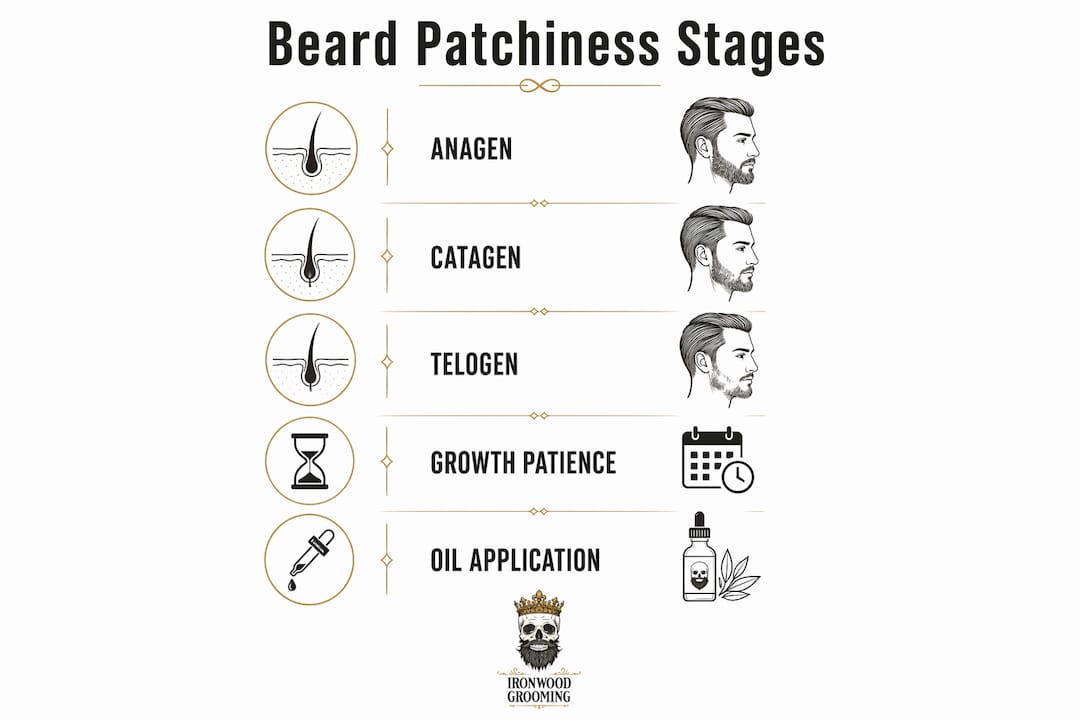
Every follicle cycles through three phases: anagen (active growth), catagen (transition), and telogen (rest). Because each follicle operates independently, your chin might be racing ahead while your cheeks are still in the resting phase. That timing gap is what you see in the mirror as patchiness.
Genetics controls the number of follicles you have, where they sit, and how sensitive they are to androgens like testosterone and DHT. Two men with identical hormone levels can grow completely different beards because their follicles respond differently at the cellular level. Your DNA sets the ceiling, but the growth cycle determines what you see at any given week.
Key factors driving uneven beard growth:
- Follicle androgen sensitivity: Low sensitivity means thinner, slower-growing hair in specific zones, often the cheeks
- Asynchronous growth cycles: Some follicles grow while others rest, creating temporary sparse patches
- Age and maturation: Follicles continue developing through your late twenties, so early patchiness often improves with time
- Ethnic background: Men of East Asian or Native American descent tend to have fewer androgen receptors in facial follicles, producing thinner coverage patterns
- Structural vs. temporal patchiness: Temporary gaps resolve with length; fixed gaps reflect permanent follicle distribution
Most patchiness you see early in growth is temporal, not structural. Judging your beard at week three is like judging a building by its scaffolding.
How to manage and visually improve a patchy beard
Patience is the most underused grooming tool you own. Allowing 4–8 weeks of uninterrupted growth gives longer hairs time to overlap sparse zones, visually filling gaps without a single new follicle. Trimming early resets that process every time.
Beyond patience, your lifestyle directly affects follicle health. Stress raises cortisol, which pushes follicles into the resting phase prematurely. Poor sleep compounds this. Vitamin deficiencies, particularly in protein, iron, and B vitamins, can impair the quality of hair your existing follicles produce. None of these fixes will override your genetics, but they remove obstacles that make patchiness worse than it needs to be.
Practical management tips that actually move the needle:
- Let it grow: Resist trimming for at least 4–6 weeks so longer hairs can cover thinner areas
- Shape strategically: A barber who understands beard structure can create the illusion of fullness through clean lines and proportion
- Hydrate the skin beneath: Dry, flaky skin weakens the hair shaft at the root. Daily beard oil application keeps the follicle environment healthy
- Prioritize sleep and stress management: Chronic stress is a genuine driver of stress-related hair loss that most men overlook
- Eat for your follicles: Lean protein, zinc, and biotin-rich foods support the hair growth cycle from the inside out
- Avoid aggressive grooming: Harsh alcohols in cheap products, over-trimming, and heat tools cause breakage that mimics patchiness
Pro Tip: Apply beard oil right after washing while skin is still slightly damp. The oil locks in moisture at the follicle level, reducing the dryness and inflammation that make sparse areas look worse.

Recognizing medical conditions versus normal patchiness
Normal genetic patchiness develops gradually, stays consistent over time, and follows your family’s facial hair pattern. Medical patchiness is different. It appears suddenly, often in smooth circular patches, and may come with skin changes like redness, scaling, or inflammation.
Alopecia barbae is the condition most men need to know about. It’s an autoimmune disorder where the immune system attacks hair follicles, producing smooth, round bald patches along the jawline and cheeks. According to a 2023 review in the Journal of Clinical Medicine, alopecia areata barbae accounts for roughly 28% of all alopecia areata cases. Unlike genetic patchiness, it requires medical diagnosis and targeted treatment, not grooming fixes.
Other conditions that affect beard growth:
- Tinea barbae (ringworm of the beard): A fungal infection causing scaly, itchy, red patches, more common in warm, humid climates
- Seborrheic dermatitis: Skin inflammation beneath the beard that disrupts follicle function and is often mistaken for dry skin
- Folliculitis: Bacterial inflammation of follicles that, in severe cases, causes scarring and permanent hair loss in affected spots
- Lupus and lichen planus: Autoimmune conditions that produce patchy facial hair alongside visible skin symptoms
“It’s not predictable. It could spontaneously resolve, or it could spread if you don’t get treatment.” — Dr. Anthony, Cleveland Clinic, on alopecia areata
See a dermatologist if your patchiness appeared suddenly within days or weeks, if patches are smooth and circular, or if you notice skin changes alongside the hair loss. Genetic patchiness does not require medical treatment. Medical patchiness does, and waiting makes it harder to manage.
Ironwoodgrooming’s expert grooming approach for patchy beards
At Ironwoodgrooming, the philosophy is straightforward: work with your beard’s natural pattern, not against it. Trying to force growth in dormant zones wastes time and damages confidence. The men who wear their beards best are the ones who understand their follicle map and groom accordingly.
Expert barbers consistently recommend the same approach: embrace your natural density, focus on shape, and feed your skin the moisture it needs to perform. A well-shaped beard with clean lines reads as full even when the coverage is uneven. Shape creates the illusion that density alone cannot.
Ironwoodgrooming’s small-batch beard oils are built specifically for this. The Lucky Beard Oil delivers deep hydration without grease, keeping the skin beneath your beard healthy so existing follicles can do their best work. For men dealing with coarse or irritated skin under a patchy beard, the Eviden Essential Beard Oil uses natural ingredients to nourish both the hair shaft and the skin layer where follicle health starts.
A solid daily routine for managing a patchy beard:
- Cleanse with a quality beard soap and conditioner to remove buildup without stripping natural oils
- Apply beard oil while skin is damp to lock in moisture at the follicle level
- Brush with a boar bristle brush to train hair direction and distribute oil evenly
- Visit a barber every 3–4 weeks for shaping that works with your natural growth pattern, not against it
The most confident beard is not always the fullest one. It’s the one that’s been understood, shaped, and cared for with intention.
For a complete starting point, Ironwoodgrooming’s beginner beard regimen walks you through the full routine step by step.
Summary: what you now know about patchy beard causes and management
Patchy beards are primarily a product of genetics and the natural, asynchronous hair growth cycle. Most early patchiness is temporary. Most men quit before overlap has a chance to work.
- Genetics sets the foundation: Follicle number, distribution, and androgen sensitivity are inherited, not earned
- Growth cycles cause temporary gaps: Independent follicle timing creates uneven progress that resolves with length and patience
- Lifestyle factors matter: Sleep, stress, and nutrition affect follicle health even when they cannot override your DNA
- Medical conditions require medical care: Sudden circular patches, skin changes, or rapid onset patchiness warrants a dermatologist visit, not a grooming fix
- Grooming shapes the outcome: Proper shaping, beard oil, and patience produce a stronger result than any attempt to force dormant follicles awake
Understanding how to fix a patchy beard starts with knowing which kind of patchiness you’re dealing with. Structural or temporal, genetic or medical, the right response depends on an honest read of what’s actually happening at the follicle level.
Key Takeaways
Patchy beards result from genetic follicle distribution and asynchronous growth cycles, with lifestyle, medical conditions, and grooming all shaping the final outcome.
| Point | Details |
|---|---|
| Genetics drives patchiness | Follicle sensitivity to androgens and distribution are inherited, setting your beard’s density ceiling. |
| Growth cycles cause temporary gaps | Independent follicle timing creates uneven progress that improves after 4–8 weeks of uninterrupted growth. |
| Medical patchiness needs a doctor | Sudden circular patches or skin changes signal alopecia barbae or other conditions requiring clinical treatment. |
| Lifestyle supports follicle health | Chronic stress raises cortisol, pushing follicles into early rest and worsening existing patchiness. |
| Shape and grooming change perception | Proper shaping and daily beard oil use improve the appearance of uneven growth without forcing new follicles. |

