


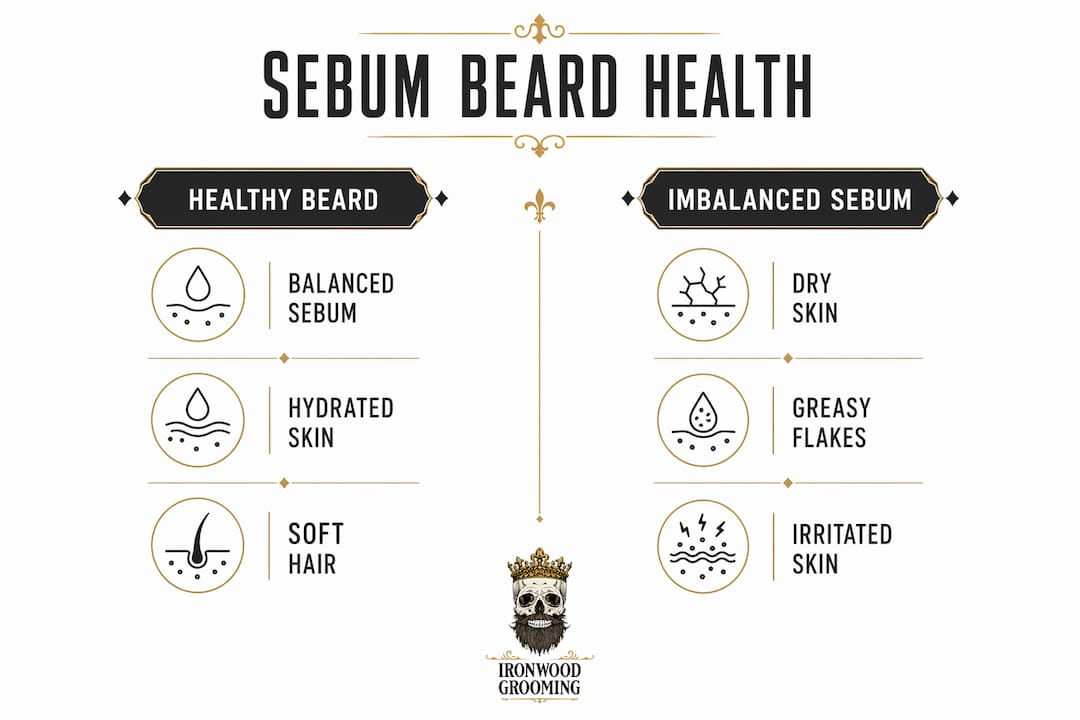
Sebum is a natural oil produced by sebaceous glands attached to your hair follicles. It is your skin’s first line of defense — lubricating the hair shaft, maintaining the skin’s protective barrier, and preventing the dryness and flaking that derail most men’s beard care routines. When sebum production is balanced, your beard stays conditioned and your skin stays comfortable. When it is not, you get itch, beardruff, and irritation that no amount of product seems to fix. Understanding how sebum actually works gives you the foundation to build a routine that solves problems instead of creating new ones.
How Sebaceous Glands Work
Your face has a high concentration of sebaceous glands, but their density under your beard is not uniform. The chin and upper lip carry more glands per square centimeter than the cheeks, which is why some areas of your beard feel oilier than others. Each gland connects directly to a hair follicle and releases sebum through a duct that opens at the skin surface.
Sebum’s composition matters more than most men realize. It contains:
- Triglycerides and free fatty acids that lubricate the hair shaft and skin surface
- Wax esters that form a protective film against moisture loss
- Squalene that acts as an antioxidant, protecting skin cells from oxidative damage
- Cholesterol that supports the skin’s structural barrier function
The problem with longer beards is what researchers call the wick effect. Beard hair draws sebum away from the skin surface and distributes it along the hair shaft, leaving the skin underneath dry even when the beard tips feel oily. This is a distribution problem, not a hygiene problem. The longer your beard grows, the further sebum has to travel — and the less of it actually reaches the skin where it is needed most.
Pro tip: If your skin under your beard feels tight and dry while your beard looks shiny, the wick effect is the cause. You need to supplement your natural oil production with a lightweight beard oil applied directly to the skin — not just worked through the hair.

Your sebaceous glands produce a fixed amount of sebum each day. A short stubble gets full coverage. A four-inch beard gets the same volume spread across four times the surface area. Natural sebum alone cannot maintain healthy beard skin past a certain length — which is exactly why beard oil exists.
What Sebum Imbalance Does to Your Beard Skin
Not all beard flaking signals the same problem, and treating them the same way is one of the most common mistakes men make.
Dry skin flakes are small, white, and powdery. They appear when sebum production is too low or when harsh cleansers strip the skin’s natural oils. The fix is straightforward: gentler washing, less frequency, and daily beard oil applied to the skin.
Seborrheic dermatitis flakes are different — larger, yellowish, greasy, and often accompanied by redness and persistent itch. The cause is biological. Malassezia yeast lives naturally on human skin and feeds on sebum. When sebum production increases or the skin’s microbial balance shifts, Malassezia overgrows and metabolizes sebum into oleic acid. That oleic acid irritates the skin, accelerates skin cell shedding, and produces the inflamed, greasy flakes that define seborrheic dermatitis. Roughly one in eight bearded men is dealing with this — a yeast-driven inflammatory response, not simple dryness.
| Condition | Flake appearance | Root cause | Treatment approach |
|---|---|---|---|
| Dry skin | Small, white, powdery | Low sebum or over-washing | Gentle cleansing, daily beard oil |
| Seborrheic dermatitis | Greasy, yellowish, larger | Malassezia yeast overgrowth | Antifungal treatment, sebum-safe oils |
| Product reaction | Variable, localized | Irritant or allergen in product | Remove the offending product |
Aggressive washing makes both conditions worse. Stripping the skin with harsh surfactants removes sebum, triggers the glands to overproduce in response, and feeds the yeast cycle all over again. Facial skin is more sensitive and recovers more slowly from chemical disruption than scalp skin — which is why beard-specific cleansers matter. Read more on how to use beard soap the right way.
Pro tip: If your flakes are greasy and your skin looks red, add an antifungal zinc pyrithione wash to your routine two to three times per week before reaching for more moisturizer. More oil on an active yeast imbalance will feed the problem, not fix it.
How to Support Sebum Balance: The Practical Routine
Keeping your sebum in balance requires a deliberate routine built around what your skin actually needs — not what the packaging promises.
- Wash with a gentle, pH-balanced beard cleanser. Standard shampoo is formulated for scalp skin, which is thicker and more resilient. Use a beard-specific cleanser that respects the acid mantle of facial skin. Wash two to three times per week — not daily — to avoid stripping your natural oils.
- Apply beard oil directly to the skin. Work a few drops into the skin beneath your beard immediately after washing while your pores are open. This directly counters the wick effect and replenishes what the hair shaft pulls away from the surface. Ironwood’s beard oils are built on jojoba and argan bases that absorb into the skin rather than sitting on top of it.
- Choose oils with the right fatty acid profile. Jojoba oil closely mimics human sebum in its lipid structure, making it one of the most effective carrier oils for beard hydration. MCT oil — specifically caprylic acid C8 — carries antifungal properties that inhibit Malassezia growth without feeding it. Avoid oils high in oleic acid: olive oil contains roughly 73% oleic acid and castor oil roughly 89%, both of which can trigger flares in men prone to seborrheic dermatitis.
- Comb to distribute oil evenly. A quality beard comb moves both your applied oil and your natural sebum from the skin outward along the hair shaft. This mimics the distribution function that sebum performs naturally on shorter hair. See why daily combing matters for the full breakdown.
- Recognize when antifungal treatment is necessary. If itching, redness, and greasy flakes persist after two weeks of a gentle routine, you are likely dealing with active seborrheic dermatitis. A zinc pyrithione or ketoconazole wash used two to three times per week is the evidence-based first step. Moisturizing alone will not resolve a fungal imbalance.
- Stay consistent. Sebaceous glands respond to routine. Stripping and flooding the skin with oil alternately keeps your glands in a reactive cycle. A steady, gentle routine signals your skin to normalize its own output over time.
How Beard Oil Replicates Sebum — and Why It Works
Beard oil effectiveness comes down to molecular compatibility. The best beard oils are not fragrance delivery systems. They are functional lipid blends designed to penetrate the hair cuticle and hydrate the skin beneath — stepping in where sebaceous glands cannot keep up.
Carrier oils like jojoba, argan, and sweet almond contain fatty acids that match the lipid profile of human sebum closely enough to absorb into the hair shaft rather than sitting on top of it. This penetration softens the hair from within, reduces brittleness, and prevents the micro-fractures that cause breakage. The results are measurable: daily beard oil use reduces itchiness significantly within the first week and lowers hair breakage over two weeks. Those numbers reflect what happens when you restore the lipid layer that sebum is supposed to provide but cannot sustain across a full beard.
Key benefits of a well-formulated beard oil:
- Skin barrier reinforcement through fatty acids that fill gaps in the acid mantle
- Antioxidant protection from vitamin E and squalene, shielding skin from environmental damage
- Reduced transepidermal water loss, keeping moisture locked inside the skin rather than evaporating
- Hair cuticle smoothing, which reduces friction between hairs and prevents tangling and breakage
- Microbial balance support when formulated with antifungal-friendly oils like MCT C8
The key is choosing a beard oil with a fatty acid profile that supports your skin type. Men prone to flaking and irritation should prioritize jojoba and MCT C8 over heavier oils. Men with very dry skin and no history of seborrheic dermatitis can tolerate a broader range of carrier oils. For a full breakdown of which products fit which skin type, read Switch to Hypoallergenic Beard Products for Coarse Skin.
Key Takeaways
| Point | Details |
|---|---|
| Sebum is your skin’s first defense | Sebaceous glands produce lipids that protect skin and condition beard hair from root to tip. |
| The wick effect creates hidden dryness | Longer beards pull sebum away from skin, requiring daily beard oil to compensate. |
| Not all flaking means dryness | Greasy, inflamed flakes signal yeast overgrowth and need antifungal treatment, not more oil. |
| Oil selection determines outcomes | Jojoba and MCT C8 support skin health; high-oleic oils like olive and castor feed Malassezia. |
| Consistency beats intensity | A gentle, twice-weekly wash routine with daily oil application normalizes sebum output over time. |
Why Skin Health Comes Before Beard Aesthetics
Most beard content gets this backward. Men spend hours researching beard styles and zero time understanding the skin those hairs grow from. I have seen men with genuinely impressive beards destroy their skin with daily hot showers, body wash applied to their face, and heavy oils that looked great on day one and caused chronic flaking by week three.
The uncomfortable truth is that a beard is only as healthy as the skin beneath it. Sebaceous glands do not care how long your beard is or how much product you apply. They respond to what you do to the skin. Strip it repeatedly and they overproduce. Smother it with the wrong oils and you feed the yeast that causes seborrheic dermatitis. The men who maintain genuinely comfortable, strong beards long-term are the ones who treat their facial skin with the same respect they give the beard itself.
I also push back on the idea that oily skin means you should skip beard oil. Oily skin often signals that your glands are overcompensating for chronic stripping. Introducing a lightweight, sebum-compatible oil like jojoba can actually signal your glands to calm down — the skin reads the lipid availability and reduces its own output. That is not a theory. That is how sebaceous regulation works.
Build from skin health outward, not from aesthetics inward. The Beginner Beard Regimen is the right starting point if you are building from scratch.
— Robert, Ironwood Grooming
FAQ
What is sebum and why does it matter for beards?
Sebum is a lipid-rich oil secreted by sebaceous glands attached to hair follicles. It lubricates both the skin and beard hair, maintains the skin’s protective acid mantle, and prevents moisture loss beneath the beard.
Why does my skin feel dry even though my beard looks oily?
The wick effect causes beard hair to draw sebum away from the skin surface and distribute it along the hair shaft. The skin underneath becomes dry while the beard tips appear oily — requiring supplemental beard oil applied directly to the skin to compensate.
What causes beard dandruff and is it the same as dry skin?
Beard dandruff caused by Malassezia yeast is not the same as dry skin flaking. Yeast-driven dandruff produces greasy, yellowish flakes with redness and itch. Dry skin flakes are small, white, and powdery. The treatment for each is different — antifungal for yeast, gentle hydration for dryness.
Which oils are safe for a beard prone to flaking?
Jojoba oil and MCT caprylic acid C8 are the safest choices for flake-prone beards. Both hydrate without feeding Malassezia yeast. Avoid olive oil and castor oil — both are high in oleic acid and can worsen seborrheic dermatitis.
How often should I wash my beard to keep sebum balanced?
Two to three times per week with a gentle, pH-balanced beard wash. Daily washing with harsh surfactants strips sebum, triggers gland overproduction, and disrupts the microbial balance that keeps yeast in check.
Keep Reading
- Beard Itch: Why It Happens and How to Stop It for Good
- Why Natural Ingredients Matter in Beard Care
- Switch to Hypoallergenic Beard Products for Coarse Skin
Part of the Ironwood Regimen Series
This post is part of the Beard Itch + Beardruff Regimen
Get the full routine for stopping itch and beardruff at the source — clean, hydrate, seal.
See the Itch Killer Regimen →
