


Sandalwood is the creamy, warm one. Cedarwood is the dry, crisp one. If you want a long-lasting perfume base with a soft, milky finish, reach for sandalwood. If you want a fresh, affordable, everyday wood that projects without asking your wallet to work overtime, cedarwood is your man.
- Perfume base note: sandalwood, for its slow, creamy dry-down
- Everyday beard oil or grooming: cedarwood, for its bright projection and lower cost
- Budget or sustainability concerns: cedarwood wins, since sandalwood’s best sources face real supply pressure
Pro Tip: Can’t decide? Layer them. Cedarwood opens the scent story, sandalwood finishes it.
Key Takeaways
Sandalwood delivers a creamy, long-lasting base note while cedarwood offers a dry, affordable, fast-projecting scent, so your choice should follow your use case, not habit.
| Point | Details |
|---|---|
| Scent character | Sandalwood is creamy and milky; cedarwood is dry, sharp, and resinous. |
| Longevity vs. projection | Cedarwood projects fast and fades; sandalwood projects softly but lasts far longer. |
| Price and sourcing | Sandalwood costs more due to overharvesting pressure on species like Santalum album. |
| Best everyday pick | Cedarwood suits daily beard oil and grooming for affordability and freshness. |
| Ironwoodgrooming match | Choose Authentic or Eviden for cedarwood-style wear, Crown for a sandalwood-style base. |
Table of Contents
- Cedarwood Vs. Sandalwood at a Glance
- What Does Each Wood Actually Smell Like?
- Which Species and Regions Produce Each Oil?
- Essential Oil, Absolute, or Something Else?
- How Do They Perform in Perfume and Beard Oil?
- Which Wood Should You Choose?
- What Safety and Authenticity Checks Matter?
- Why We Pick Woods Deliberately, Not by Trend
- Which Ironwood Beard Oil Matches Your Scent Preference?
- Sources
Cedarwood Vs. Sandalwood at a Glance
Both woods show up constantly in beard oils, colognes, and diffusers, but they behave nothing alike once they hit your skin.
| Dimension | Cedarwood | Sandalwood |
|---|---|---|
| Scent profile | Dry, resinous, pencil-shaving sharpness | Creamy, milky, balsamic sweetness |
| Botanical source | Cedrus atlantica, Juniperus virginiana | Santalum album, Santalum spicatum |
| Primary use | Grooming, everyday fragrance, diffusers | Perfume base notes, meditation blends |
| Longevity & projection | Strong initial throw, moderate hold | Weak throw, exceptional longevity |
| Price & sourcing | Widely available, affordable | Pricier, some species overharvested |
- Cedarwood hits fast and fades in a few hours; sandalwood barely announces itself but lingers for a full day.
- Cedarwood is nearly always cheaper because the trees that supply it aren’t under the same regulatory pressure that Indian sandalwood faces.
- Both are woody enough to sit in the same “warm” fragrance family, yet they read completely differently on skin.
Pro Tip: Blend a cedarwood-forward opening with a small sandalwood accent underneath. You get immediate impact plus a base that outlasts the top notes.
What Does Each Wood Actually Smell Like?
Cedarwood: dry, sharp, and a little smoky
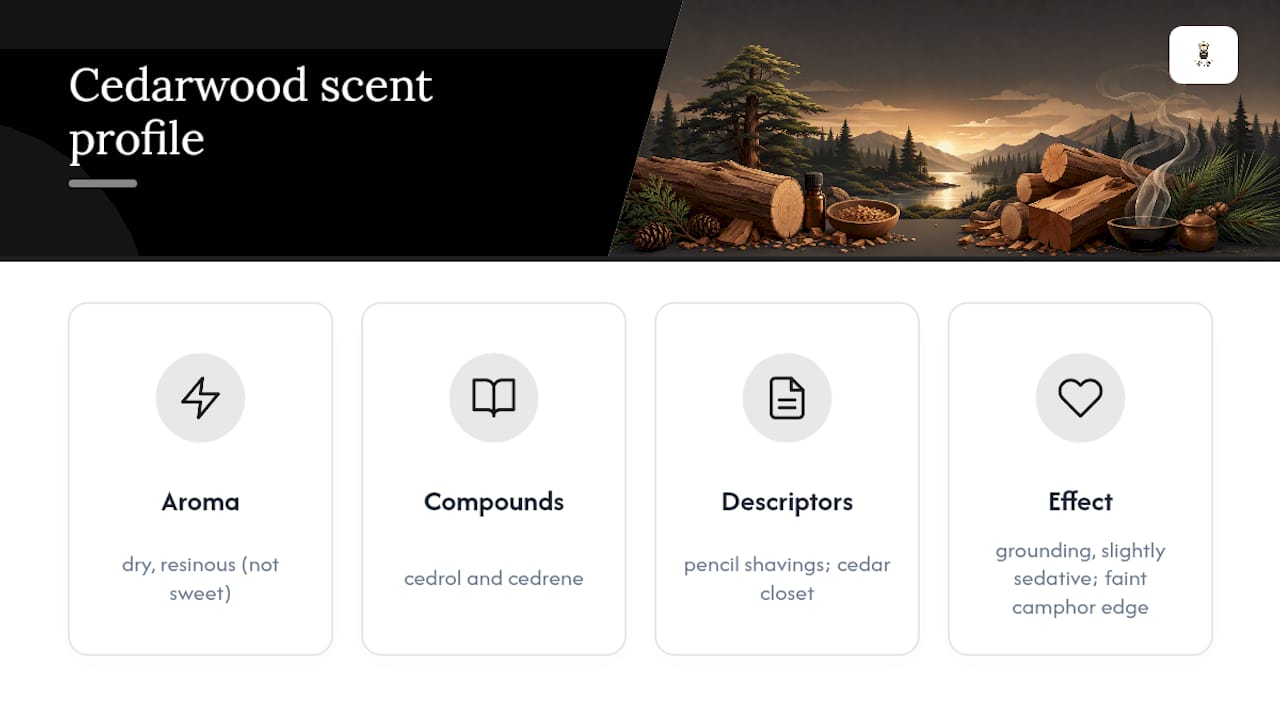
Cedarwood smells like a freshly sharpened pencil, a cedar chest, or a woodshop floor. It’s resinous rather than sweet, and some varieties carry a faint camphor edge that reads almost medicinal. That dryness comes from cedrol and cedrene, the sesquiterpenes responsible for cedarwood’s grounding, slightly sedative character in aromatherapy.
Common descriptors: pencil shavings, cedar closet, dry forest floor, faint smoke, sharp wood.
Sandalwood: creamy, milky, and quietly sweet
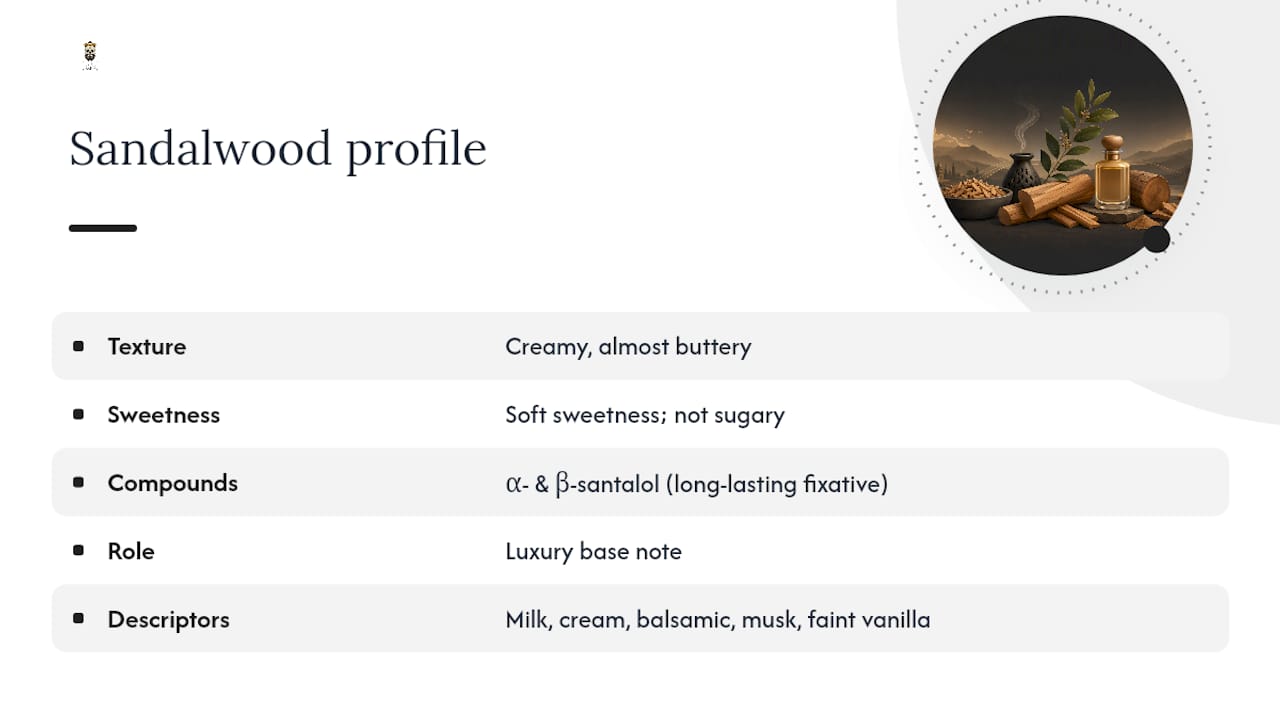
Sandalwood is the opposite sensory experience. It reads as creamy and almost buttery, with a soft sweetness that never tips into sugary. That signature comes from α- and β-santalol, the compounds that give sandalwood its fixative, long-lasting base-note quality. Where cedarwood feels like a workshop, sandalwood feels like warm skin.
Common descriptors: milk, cream, balsamic sweetness, soft musk, faint vanilla undertone.
Comparative fragrance guides consistently frame sandalwood as the luxury base and cedarwood as the affordable, hardworking structural note, and that framing holds up on the scent comparison EatHealthy365 published once you smell both side by side.
Which Species and Regions Produce Each Oil?
Not all cedarwood or sandalwood is created equal, and the species behind the bottle changes the smell more than most people expect.
Sandalwood sources:
- Santalum album (Indian Mysore sandalwood): the gold standard for creaminess, now heavily restricted
- Santalum spicatum (Australian sandalwood): sharper, drier, and more available
- Hawaiian sandalwood: rare, often blended, with a lighter profile
Cedarwood sources:
- Cedrus atlantica (Atlas cedar, Morocco): softer and slightly sweeter
- Juniperus virginiana (Virginia cedar, US): sharper, more classic “pencil” scent
- Texas cedar: dry and rugged, close cousin to Virginia cedar
Labeling gets murky here, since Virginia cedarwood actually comes from a juniper species, not a true cedar. Atlas cedar tends to smell noticeably sweeter than its Virginian counterpart, a variance well documented in the Edens Garden comparison of cedarwood and sandalwood types.
Pro Tip: Always check the botanical name on the label, not just the word “cedarwood” or “sandalwood.” The Latin name tells you which plant, and therefore which scent, you’re actually buying.
Essential Oil, Absolute, or Something Else?
How an oil gets from tree to bottle changes both its aroma and its price tag. Sandalwood is almost always steam-distilled from aged heartwood, a slow process that concentrates the santalols and drives up cost. Cedarwood is also typically steam-distilled, but from more abundant wood, which keeps prices grounded.
- Steam-distilled essential oil: the purest, truest-to-source version of either scent
- Absolute: solvent-extracted, more concentrated, common when the raw material is scarce
- Diluted blend or “accord”: cut with a carrier, often marketed as a budget alternative
Extraction method directly shapes what lands on your skin, a distinction the PureOilsIndia breakdown of cedarwood and sandalwood oil lays out clearly for anyone comparing bottles side by side.
How Do They Perform in Perfume and Beard Oil?
Cedarwood acts like a structural note. It projects fast, gives a blend its initial backbone, and fades within a few hours. Sandalwood works as a fixative, a scent that barely projects on its own but anchors everything else and refuses to quit.
What pairs well with each:
- Cedarwood: citrus, bergamot, black pepper, vetiver, tobacco
- Sandalwood: rose, jasmine, vanilla, amber, patchouli
For a beard oil that lasts through a full workday, a cedarwood-forward blend with a light sandalwood accent gives you both the fresh opening and the slow, skin-warm finish. Practitioners often describe this as a “walk in the woods” effect, cedarwood as the crisp trailhead and sandalwood as the warm cabin at the end, an approach the EatHealthy365 guide on comparing the two scents recommends for exactly this reason.
Carrier oil choice matters just as much as the wood note itself, and choosing the right carrier oil affects how far that scent throws and how long it holds on coarse facial hair.
Pro Tip: In a small room or on skin close to your face, cut the ratio toward sandalwood. In open air or a large diffuser, lean cedarwood, since it needs more volume to register.
Which Wood Should You Choose?
Match the wood to the job, not the other way around.
- Beard oil for daily wear: cedarwood, for affordable, all-day freshness
- Evening perfume or date-night scent: sandalwood, for depth and staying power
- Meditation or focus space: sandalwood, favored for its calming, grounding presence
- Budget-conscious diffuser blend: cedarwood, hands down
- Closet or drawer freshener: cedarwood, since its dry sharpness cuts musty odors well
- If sustainability is a top concern, cedarwood carries far less pressure than restricted sandalwood species.
- If you want a scent that survives from your morning routine through an evening dinner, sandalwood earns its higher price.
- If you’re new to either scent, cedarwood is the gentler, cheaper way to learn what wood notes do in a blend.
What Safety and Authenticity Checks Matter?
Both oils are generally well tolerated on skin when diluted properly, but neither belongs undiluted straight from the bottle.
- Dilute to roughly 1 to 3% in a carrier oil for topical grooming use, and always patch-test on your forearm 24 hours before applying to your face.
- Ask for a GC/MS report before buying sandalwood in particular, since its high price makes it a frequent target for cheap “accords” and synthetics.
- Confirm the botanical name (Santalum album vs. Santalum spicatum, for instance) rather than trusting the word “sandalwood” alone.
- Genuine oils smell slightly different bottle to bottle, since natural variation is normal, a point covered well in ThePerfumeSampler’s guide to why fragrance batches vary.
Sourcing matters as much as safety. Indian Mysore sandalwood has faced severe overharvesting, which is the direct reason it costs more and why suppliers increasingly turn to Australian sandalwood instead. Consumer health guides also flag standard dilution guidance for cedarwood before topical use, so treat that caveat as equally true for sandalwood.
Why We Pick Woods Deliberately, Not by Trend
Wood notes are the backbone of a good beard oil, but only if the scent survives contact with your skin’s own chemistry and your day’s temperature swings. We weigh skin safety, realistic longevity, and honest pricing before a wood note ever makes it into a formula, because a beard oil that smells great in the bottle and disappears by lunch isn’t doing its job.
Which Ironwood Beard Oil Matches Your Scent Preference?
Once you know whether you lean cedarwood or sandalwood, matching a product is simple. Ironwoodgrooming builds its beard oils around real wood chemistry, not synthetic shortcuts, so the scent you choose actually performs the way this comparison describes.
- Authentic Essential Beard Oil: a balanced, cedarwood-leaning everyday scent for daily wear
- Eviden Essential Beard Oil: a refined, wood-forward blend for readers who want more depth than a basic cedarwood
- Crown Beard Oil: a richer, sandalwood-style base for evening wear or cooler weather
- Moustache Wax: holds your style while carrying a subtle wood note through the day
If sandalwood’s creamy warmth is what you’re after, the sandalwood-scented beard oil collection is the fastest way to bring that base note into your daily routine. Browse the full beard oil collection to find the wood profile that fits your grooming routine and skin.
Sources
- PMCID article on essential oils and their chemistry
- PubMed entry for sandalwood santalol research
- EPA reregistration/background on certain wood extracts and regulatory context
- Edens Garden: Comparison guide — Cedarwood vs Sandalwood

