


Every tin of beard balm on a bathroom shelf contains a material honeybees have been perfecting for millions of years. Beeswax. Not a trend. Not a gimmick. A biological substance with a molecular structure that just happens to solve three problems men deal with every day: unruly beard hair, irritated skin, and moisture that disappears the moment life gets busy.
Once you understand what beeswax actually does — chemically, physically, and on the skin — you stop choosing beard products blindly. You start choosing them with intention. This is that story.
What Beeswax Really Is — And Why It Works
Beeswax comes from worker honeybees, secreted from glands on their abdomen. Chemists have broken it down in detail. In one of the most cited analyses, Tulloch found beeswax is made of roughly 70% esters, 15% free fatty acids, and about 14% long‑chain hydrocarbons. That blend is what gives beeswax its signature behavior — firm when cool, soft when warmed, water‑resistant but not suffocating, and flexible enough to move with your beard instead of freezing it in place.
Hepburn’s work on beeswax structure explains why: the esters form a flexible lattice — a structure that grips hair without turning it stiff. That’s why a beard styled with a beeswax balm looks natural. It holds shape, but it still moves like hair, not plastic.
The fatty acids do something different. They form a semi‑occlusive barrier on the skin — meaning they slow moisture loss without sealing the skin shut. Dermatology research by Lodén shows wax‑based occlusives can reduce transepidermal water loss (TEWL) significantly while still allowing the skin to function normally. For the skin under a beard — an area that’s often dry, itchy, and shielded from ambient humidity — that reduction is meaningful.
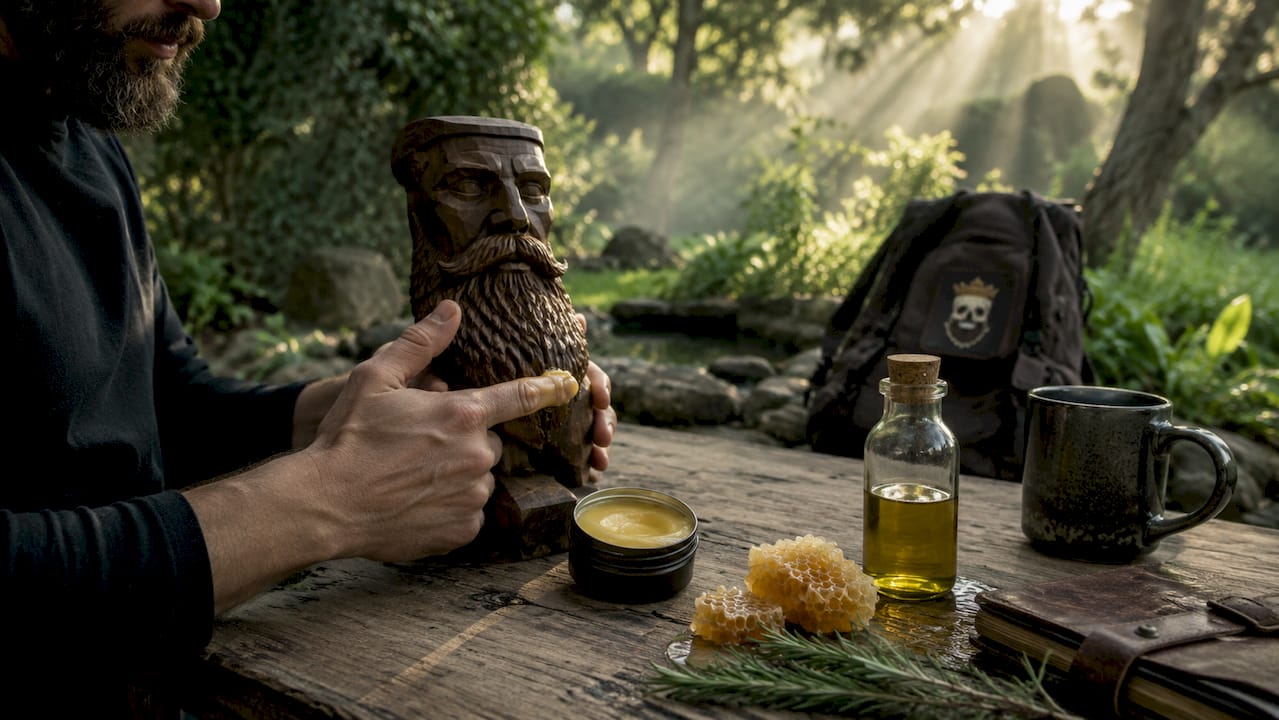
Pro tip: Warm the balm between your palms for 10–15 seconds. Beeswax softens with heat, and warming it helps the wax lattice spread evenly instead of clumping at the surface.
Why Beeswax Behaves Better Than Petroleum on Your Skin
Most men don’t compare beeswax to petroleum — but they should. Both reduce moisture loss. But they do it in completely different ways.
Petroleum (like Vaseline or mineral oil) forms a full occlusive seal. Zhai & Maibach’s research shows petrolatum can reduce TEWL by up to 99%. Nothing in, nothing out. That’s why it’s used in wound care — it traps everything underneath. But on facial skin, especially under a beard, that complete seal creates problems. It traps heat. It blocks airflow. And it creates an anaerobic environment that can shift the skin’s natural microbial balance over time.
Beeswax is different. It’s semi‑occlusive. It slows moisture loss but still allows gas exchange. The skin can breathe, regulate temperature, and maintain its natural bacterial balance. Lodén’s work on barrier creams shows beeswax‑containing emulsions support barrier recovery rather than interfering with it — a crucial distinction for men who use beard products daily.
There’s more. Beeswax has documented antimicrobial and antifungal activity. Kacániová and Hegazi both found beeswax‑based preparations can inhibit the growth of Staphylococcus aureus and Candida albicans — two organisms that commonly contribute to beardruff, irritation, and folliculitis. Under a dense beard, where warmth and humidity create ideal conditions for microbes, that protection matters.
For a deeper look at how your skin’s natural oils interact with beard products, read Sebum and Beard Health: What Every Man Should Know.
Balm vs. Butter vs. Wax — The Beeswax Concentration Story
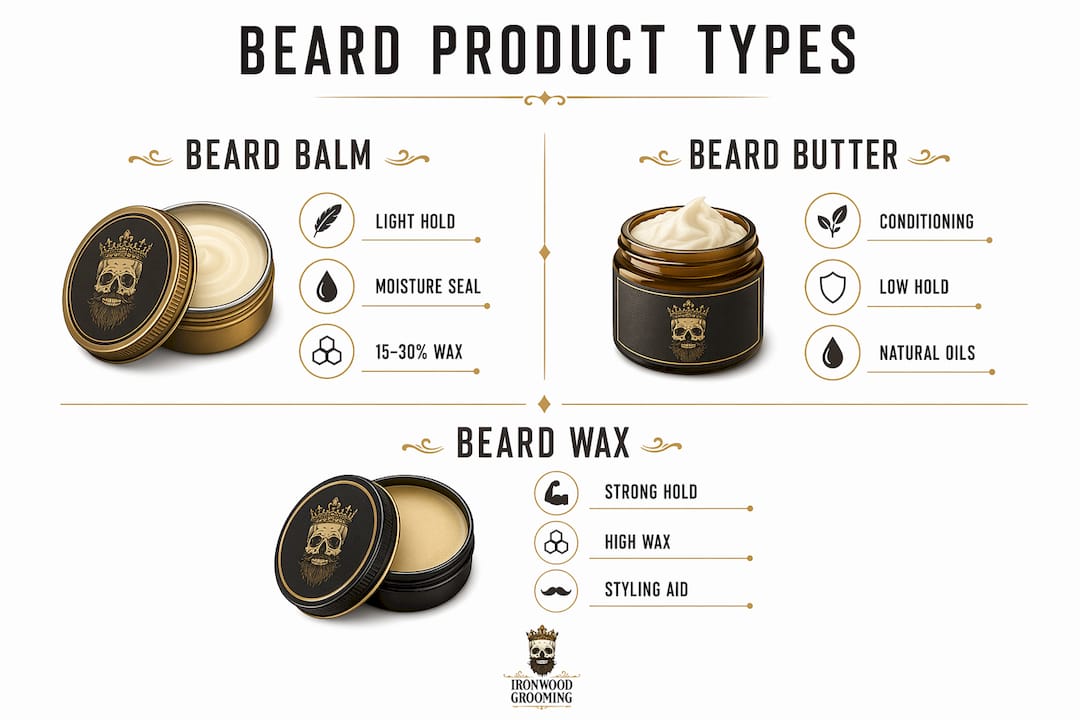
Beard butter, beard balm, and beard wax aren’t different categories of magic. They’re the same formula with different beeswax percentages. Change the concentration, and you change the entire personality of the product.
| Product | Beeswax Content | Hold Level | Best Use |
|---|---|---|---|
| Beard butter | Low to none | None to minimal | Softness, overnight conditioning |
| Beard balm | 15–30% | Light to medium | Daily shaping, moisture sealing |
| Beard wax | 30–40%+ | Medium to firm | Wind, cold, stubborn growth |
Beard butter is your recovery product — heavy on shea and cocoa butter, light on wax, built for softness and nourishment. Maranz’s analysis of shea butter explains why: its fatty acid profile makes it deeply conditioning for coarse hair.
Beard balm is the workhorse. At 15–30% beeswax, it shapes, seals, and conditions without weighing your beard down. The wax provides structure; the oils provide hydration.
Beard wax is the specialist. Above 30%, hold becomes firm and weather‑resistant. Great for wind, cold, or formal styling. Not great for daily use unless you enjoy buildup and follicle congestion.
How to Apply Beeswax Products the Right Way
Beeswax works beautifully — but only if you apply it correctly. Most men get it wrong in the same two ways: they apply to bone‑dry hair, and they use too much.
Beeswax spreads best on slightly damp hair. Dampness opens the cuticle and helps the wax and oils penetrate instead of sitting on top.
- Warm the product. Melt a pea‑sized amount between your palms until it becomes a thin layer. Cold wax drags and clumps.
- Start at the skin. Work from the base of your beard outward. This ensures the skin gets conditioned and the hair shaft gets coated evenly.
- Shape with a comb or brush. A stainless steel comb distributes product cleanly. A boar bristle brush lifts and shapes longer beards.
- Wash it out properly. Beeswax needs a dedicated beard wash. Regular soap doesn’t break down the wax matrix effectively.
Pro tip: For coarse beards, apply balm in two thin layers. The first primes the hair. The second adds shape without greasiness.
What Makes a Quality Beeswax Formula
A good balm is more than beeswax. It’s the balance between wax and oils that determines whether your beard feels groomed or gummy.
For daily use, 15–30% beeswax is the sweet spot. Above 40%, the product becomes stiff and harder to wash out — fine for occasional styling, not ideal for everyday skin health.
Carrier oils matter just as much. Beeswax seals moisture; it doesn’t add it. That’s the job of oils like:
- Jojoba — Wisniak’s research shows it’s chemically similar to human sebum, making it ideal for skin absorption.
- Argan — Charrouf & Guillaume documented its vitamin E and polyphenol content, which support skin health.
- Shea butter — Maranz’s work shows its fatty acids add softness and weight to coarse hair.
If beeswax isn’t in the first five ingredients, the product probably won’t provide meaningful hold or barrier function.
Why Most Men Use Beeswax Products Wrong
After years of talking to men about their grooming routines, one pattern shows up again and again: most guys reach for the strongest product they own and use it every day. That works against you.
High‑wax products are situational tools. Great for wind, cold, or formal styling. Terrible as a Monday‑through‑Friday default. Daily use without proper cleansing leads to buildup, congestion, and irritation.
The men who get the best results rotate products based on conditions. Balm for daily shaping. Butter for recovery. Wax when the situation demands control.
The other mistake? Skipping the oil step. Beeswax seals — it doesn’t hydrate. If you apply balm over dry skin, you’re locking in dryness. A few drops of beard oil first, then balm, is the combination that actually works. Ironwood formulas are built around this principle — pairing beeswax with jojoba and argan so the product hydrates and seals in one step.
— Roberto, Ironwood Grooming
Keep Reading
- Beard Butter vs. Beard Balm: What's the Difference and Which One Wins?
- Jojoba Oil vs. Argan Oil for Beards: Which One Does Your Skin Actually Need?
- Sebum and Beard Health: What Every Man Should Know
Part of the Ironwood Regimen Series
New to beard care? Start here.
The Beginner Beard Regimen is the complete start-here guide — cleanse, hydrate, seal — for guys building their first real routine.
See the Beginner Regimen →