


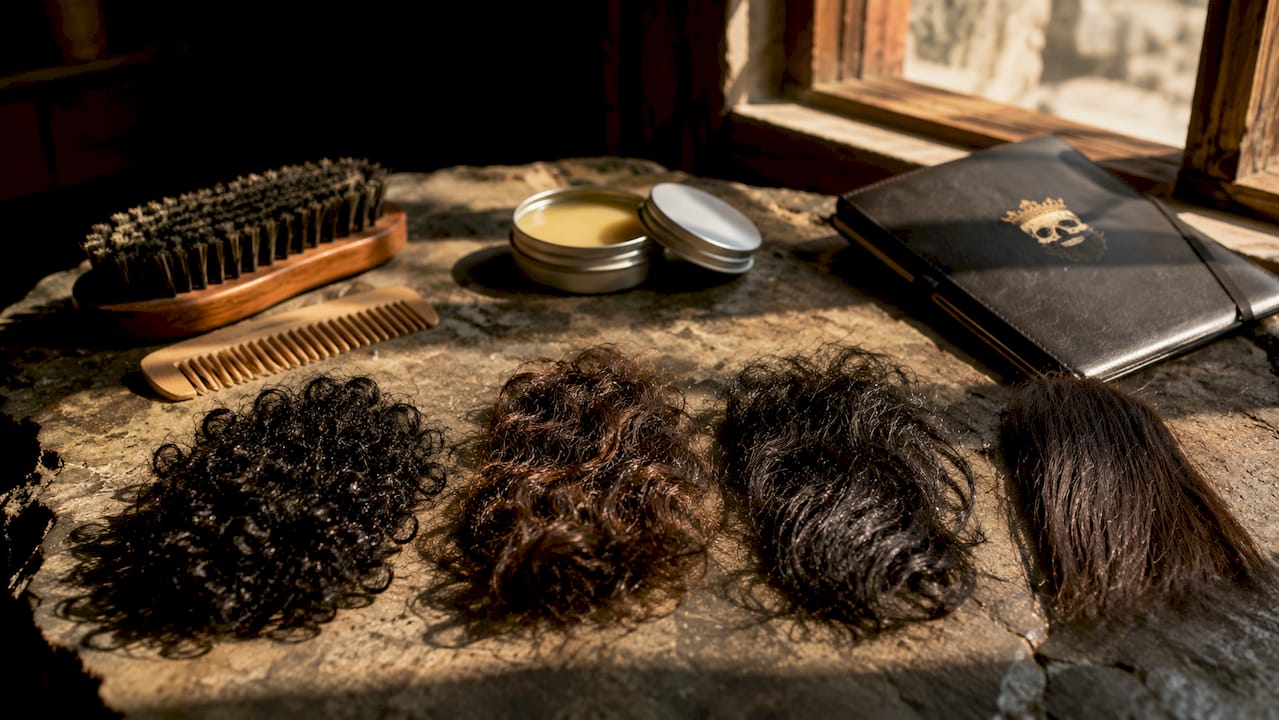
Your beard’s texture is not a preference — it is a biological fact determined by the shape of your hair follicle. That shape dictates how moisture moves through the hair shaft, how sebum distributes from the skin surface, how the hair responds to trimming, and which products actually work. Coarse, curly, wavy, and straight beards each have different moisture needs, trimming tolerances, and product requirements. Using the same routine regardless of texture is the single most common reason beard care fails.
Why Follicle Shape Determines EverythingThe cross‑sectional shape of the hair follicle determines the geometry of the hair shaft it produces. Round follicles create straight hair with a circular cross‑section. Oval follicles create wavy or curly hair with an elliptical cross‑section. Flat, ribbon‑shaped follicles create coarse, coily hair with a highly elliptical cross‑section that spirals tightly as it grows.
That geometry controls moisture behavior. Straight shafts allow sebum — your skin’s natural oil — to travel freely from root to tip. Coily shafts interrupt that flow. Sebum pools at the follicle opening and never reaches the mid‑shaft or ends. That’s why coarse and coily beards are chronically dry even when your skin produces enough oil. The hair’s structure blocks its own moisture distribution.
Most men have mixed textures — coarse on the chin, finer on the cheeks or mustache. Identifying your dominant texture gives you the roadmap for a routine that actually works.
 Moisture Routines for Coarse and Curly Beards
Coarse and curly beards lose moisture faster than any other texture because sebum cannot travel down the spiral shaft. Standard once‑daily oil application is not enough. These textures need moisture layering and heavier products that compensate for the distribution problem.
The most effective technique is the LOC method — Liquid, Oil, Cream — applied in that order. Some men with very coarse textures do better with LCO — Liquid, Cream, Oil. The sequence matters as much as the products.
- Liquid: Mist the beard with water or a water‑based leave‑in until damp.
- Oil: Apply a heavy carrier oil — castor, jojoba, or argan — while the beard is still damp.
- Cream: Seal with a thick beard butter or balm to lock in moisture.
Coarse and coily textures benefit from twice‑daily application — morning and night. Curly textures usually do well with once daily.
Detangle first. Use a wide‑tooth comb, starting at the ends and working upward. Root‑to‑tip detangling tightens knots and causes breakage.
Pro tip: Avoid heat tools. Heat strips moisture and causes frizz. Stretch curls with a wide‑tooth comb while damp and let the beard air‑dry.
Grooming Methods for Wavy and Straight BeardsWavy and straight beards distribute sebum more effectively. Their challenges are different: straight hair can look limp; wavy hair frizzes when humidity lifts the cuticle.
These textures thrive on gentle, less frequent cleansing — two to three times per week with a sulfate‑free beard wash. Daily washing removes the natural oils that give straight and wavy beards body and shine.
Brushing technique matters. A boar‑bristle brush distributes natural oils and adds fullness. Brush after applying a light beard oil. For wavy beards, brush while slightly damp to set the wave pattern.
- Cleanse 2–3× weekly with a sulfate‑free wash.
- Use lightweight beard oil — heavy butters weigh these textures down.
- Brush with a boar‑bristle brush for volume and direction.
- Use a small amount of balm for light hold.
- Finish with a fine‑tooth comb to smooth flyaways.
Pro tip: For wavy beards, apply a pea‑sized amount of balm to damp hair and let it air‑dry untouched. Touching the beard while it dries disrupts the wave pattern.
Shaping and Trimming Across All Beard TypesTexture determines trimming rules — especially whether to trim wet or dry.
Coily hair is hygroscopic. It absorbs water, swells, and elongates. When it dries, it contracts. The difference can be an inch or more. Trimming coily hair wet guarantees uneven length once dry. Always trim coarse and coily beards dry.
Straight and wavy beards don’t change length dramatically when wet. They can be trimmed wet or dry, though slightly damp trimming gives cleaner lines on wavy textures.
| Texture | Trim frequency | Wet or dry | Reason |
|---|---|---|---|
| Coarse/Coily | Every 7–10 days | Dry only | Wet elongation causes uneven dry length |
| Curly | Every 7–10 days | Dry only | Same contraction issue, less severe |
| Wavy | Every 5–7 days | Slightly damp | Damp trimming defines wave pattern |
| Straight | Every 5–7 days | Wet or dry | Minimal dimensional change |
The neckline rule is universal: two fingers above the Adam’s apple, trim everything below in a U‑shape. This prevents the beard from merging with the neck.
Products and Tools Matched to Your Beard TextureProduct weight must match texture. Heavy butters for coarse/coily. Lightweight oils for straight/wavy. Mismatching causes dryness or greasiness.
| Texture | Product weight | Best oils | Best styling product |
|---|---|---|---|
| Coarse/Coily | Heavy | Castor, argan, jojoba | Thick butter or balm |
| Curly | Medium‑heavy | Argan, jojoba, sweet almond | Butter or medium‑hold balm |
| Wavy | Light‑medium | Jojoba, grapeseed, argan | Light oil + light balm |
| Straight | Light | Jojoba, grapeseed, abyssinian | Light oil |
For tools: a boar‑bristle brush works across all textures. Wide‑tooth combs are essential for curly and coily detangling.
Pro tip: If your skin reacts easily, avoid synthetic fragrances. Dense beards trap irritants against the skin, amplifying reactions.
Key Takeaways| Point | Science |
|---|---|
| Texture = follicle shape | Flat follicles → coily hair; round follicles → straight hair |
| LOC/LCO seals moisture | Oil over damp hair slows evaporation; cream seals the barrier |
| Trim coily beards dry | Wet elongation causes uneven dry length |
| Match product weight to texture | Heavy for coarse; light for straight |
| Neckline rule is universal | Two fingers above Adam’s apple |
Most men fail at beard care because they use the same routine regardless of texture. A man with a coily beard grabs a lightweight oil meant for straight hair and wonders why his beard feels like straw by noon. Another man with a fine beard uses heavy butter and looks greasy all day. Texture‑blind grooming is the biggest mistake in beard care — and the easiest one to fix.
The LOC/LCO methods changed everything for me. They work because they follow the physics of moisture movement. Oil on dry hair seals water out. Oil on damp hair seals water in. That one shift produces measurable softness within days.
The other mistake men make is trimming too early. Patchiness in the first four to six weeks is normal. Let the beard fill in before shaping. Learn your texture, then build your routine around it. The beard that suits you best is the one you’ve learned to read.
— Roberto, Ironwood Grooming
Keep Reading
- Beard Training for Coarse, Latino, or Mixed-Texture Beards
- Beard Conditioning Routines: Examples for Every Man
- Beard Care 101: Essential Grooming Tips for Beginners
Part of the Ironwood Regimen Series
New to beard care? Start here.
The Beginner Beard Regimen is the complete start-here guide — cleanse, hydrate, seal — for guys building their first real routine.
See the Beginner Regimen →
