


Clean beauty is an unregulated marketing term that generally means a product is made without ingredients some scientists, advocacy groups, or retailers consider potentially harmful to your body or the environment. That’s the whole definition. Here’s the catch: there’s no single rulebook. A brand, a retailer, and a certifier can each draw the line in a different place, and the FDA does not define “clean” for cosmetics at all. The FTC’s Green Guides police false claims after the fact, and groups like the Clean Beauty Coalition push for a broader standard built on transparency and equity, not just a chemical checklist.
This guide breaks down what “clean” actually excludes, who gets to decide, what the science really shows, and how you separate a genuine formulation standard from a sticker slapped on a bottle. Ironwood Grooming builds beard care against these same principles, and we’ll show you exactly how.
- The term isn’t legally defined — it’s shaped by brands, retailers, and certifiers, each with their own list.
- Ingredient categories most often excluded include parabens, phthalates, synthetic fragrance, and certain chemical sunscreen filters.
- Verification beats vocabulary — a published ingredient policy backed by third-party testing carries more weight than a green leaf icon.
Key Takeaways
Clean beauty is a marketing term without legal definition, so the only reliable way to judge a “clean” claim is to check the published ingredient list against a verifiable standard, not the badge on the bottle.
| Point | Details |
|---|---|
| No legal definition exists | The FDA does not define “clean beauty,” so brands, retailers, and certifiers each set their own standard. |
| Watch the “fragrance” line | It can legally hide dozens of undisclosed compounds under trade-secret protection. |
| Certification beats self-declaration | EWG Verified, MADE SAFE, and similar programs require documented, audited criteria. |
| Context changes the science | Dose, exposure route, and product type (rinse-off vs. leave-on) all affect real-world risk. |
| Ironwood Grooming publishes full formulas | The Vegan Simple Beard Bundle is small-batch, plant-based, cruelty-free, and formulated for coarse beards and sensitive skin. |
Table of Contents
- What Does Clean Beauty Mean? Ingredients Commonly Left Out
- Who Decides What Counts as Clean Beauty?
- What the Research Actually Says About These Ingredients
- FDA, MoCRA, and the FTC Green Guides: What U.S. Law Actually Covers
- How to Evaluate a “Clean” Claim Before You Buy
- How Ironwood Grooming Builds Clean Into Every Formula
- Where the Clean Beauty Movement Came From
- Clean Beauty and the Environment: More Than Just Your Skin
- Is Clean Beauty Worth It? Benefits and Real Limitations
- How to Spot Genuinely Clean Beauty Beyond the Marketing
- An Honest Read on the Clean Beauty Conversation
- Get Your Beard Routine on a Genuinely Clean Standard
- Sources
What Does Clean Beauty Mean? Ingredients Commonly Left Out
Grooming products with a legitimate “clean” claim typically leave out a recurring cast of ingredients. Knowing them by name is the fastest way to read a label like someone who’s done this before.
- Parabens (methylparaben, propylparaben, butylparaben): preservatives with some evidence of hormone disruption at high exposure, though real-world dose remains debated.
- Phthalates: plasticizers sometimes used to stabilize fragrance, flagged in reproductive health research.
- Synthetic fragrance: listed simply as “fragrance” or “parfum,” a legal loophole that lets companies protect trade-secret formulas without disclosing the dozens of compounds inside.
- Chemical UV filters like oxybenzone: effective sun protection but under scrutiny for hormone activity and coral reef damage.
- Certain preservative systems, including some formaldehyde-releasing agents.
- 1,4-dioxane: not an added ingredient but a manufacturing byproduct that can contaminate sulfate-based cleansers.
The “fragrance” line on an ingredient list is doing more work than any other word on the bottle. Because the FDA classifies fragrance formulas as trade secrets, a single word can legally represent 50 or more undisclosed compounds, some of which are allergens.
The number that matters: the EPA has documented 1,4-dioxane as a contaminant of concern that can turn up in cosmetics as a byproduct of ethoxylation, a manufacturing step used to make some detergents gentler. It’s never intentionally added, which is exactly why it rarely shows up on a label you’re scanning.
Who Decides What Counts as Clean Beauty?
Four different groups draw the line on what “clean” means, and none of them agree completely.
- Brands write their own avoid lists. Some publish the full policy with rationale, others just print “clean” on the box with nothing behind it. Transparency is the tell. If a brand won’t show you the list, assume there isn’t much of one.
- Retailers run their own screening programs and ban specific ingredients from shelves. Useful as a first filter, but every retailer’s list is different, and a product can pass one chain’s screen while failing another’s.
- Certifiers like EWG Verified, MADE SAFE, and NSF-type programs require documentation and sometimes audits before they’ll put a seal on a product. This is the closest thing to independent verification in the category.
- Communities build their own resources: crowdsourced ingredient databases, ingredient-scanning apps, and forums where people compare notes on formulas and flare-ups. These move faster than regulation but carry no formal accountability.
The Environmental Defense Fund has proposed that brands adopt clear, published criteria with third-party verification instead of self-declared standards, precisely because the four-framework mess above confuses more than it clarifies.
Pro Tip: Before trusting any “clean” badge, ask one question: is this claim backed by a published, checkable standard, or is it the brand grading its own homework?
What the Research Actually Says About These Ingredients
Peer-reviewed science on these ingredients is real, but it’s more nuanced than either side of the clean beauty debate usually admits. Reviews indexed on PubMed have raised concerns about endocrine and reproductive effects tied to parabens, phthalates, and some fragrance components, but the same reviews are careful to note that dose, frequency, and route of exposure change the risk picture substantially. A trace amount in a rinse-off soap is not the same exposure as a leave-on product applied daily for years, which matters more for a beard oil sitting on your skin than for a shampoo washed down the drain in seconds.
- Parabens: some studies link high concentrations to hormone activity in lab models; real-world topical exposure at typical concentrations shows weaker, less consistent effects.
- Phthalates: stronger reproductive-health signal in the research, one reason many brands dropped them years before “clean” became a marketing category.
- Fragrance allergens: the best-documented risk of the group, since contact dermatitis from fragrance is common and well-studied.
- Oxybenzone: flagged for both endocrine activity and coral reef toxicity, though evidence strength varies by study design.
Here’s the part most marketing skips: presence of an ingredient is not proof of harm. Context is everything. It’s also worth knowing that “natural” doesn’t automatically mean gentler. Public-health reviews caution that botanical extracts and essential oils can be just as irritating or allergenic as their synthetic counterparts, sometimes more so, especially on skin already dealing with irritation under a beard.
FDA, MoCRA, and the FTC Green Guides: What U.S. Law Actually Covers
No federal agency defines or certifies “clean beauty.” What they do regulate is narrower, but it’s not nothing.
- The FDA maintains lists of prohibited and restricted cosmetic ingredients and provides product testing guidance, but stops well short of policing marketing vocabulary.
- The Modernization of Cosmetics Regulation Act (MoCRA) expanded FDA authority over facility registration, adverse event reporting, and safety substantiation for cosmetic manufacturers. It raised the bar on documentation. It still never mentions the word “clean.”
- The FTC Green Guides are the sharpest tool consumers actually have. They define what counts as a deceptive environmental or safety claim and require advertisers to substantiate what they promise. A brand claiming “non-toxic” or “chemical-free” without backup can be challenged under this framework.
That last point deserves emphasis: the Green Guides are enforcement after the fact, not pre-approval. Nobody checks a “clean” label before it hits shelves. The system relies on complaints, competitor challenges, or FTC action, which means plenty of unsubstantiated claims sit on shelves for years before anyone questions them.
How to Evaluate a “Clean” Claim Before You Buy
Run any grooming product through this checklist before you trust the label.
- Read the full ingredient list on the product page, not just the marketing copy above it. Watch for the word “fragrance” standing alone, and note whether any entries look vague or incomplete.
- Check whether the claim is certified or self-declared. A third-party seal like EWG Verified or MADE SAFE means someone outside the company reviewed the formula against published, documented criteria. A badge with no visible standard behind it is just design work.
- Compare the brand’s avoid list against retailer-banned lists and independent resources like EWG’s Skin Deep database. If a brand’s list is shorter than what a major retailer already screens out, that’s a signal, not a coincidence.
- Ask direct questions and watch for evasive answers. Does the brand disclose full formulas? Do they test with a third party? A company confident in its formulation will answer both questions without hedging.
Red flags worth memorizing: a vague seal with no criteria attached, an avoid list that conveniently excludes ingredients the brand doesn’t use anyway, and “pixie-dusted” actives, meaning a trendy ingredient listed in a concentration too low to do anything, included purely for the label appeal.
Pro Tip: Save this checklist as a screenshot on your phone. Pull it up in the store before you buy, not after. Ironwoodgrooming’s breakdown of grooming product transparency walks through label reading in more detail if you want the deeper version.
How Ironwood Grooming Builds Clean Into Every Formula
We build every formula small-batch, which means no filler ingredients added just to stretch a production run, and no shortcuts taken to hit a lower price point at your expense. Every product is plant-based and vegan-friendly, cruelty-free from raw material to finished bottle, and formulated specifically for coarse beards and the skin irritation that comes with growing one out.
- We publish full ingredient lists on every product page. Nothing hides behind a trade-secret fragrance blend.
- Formulas avoid the synthetic preservatives and filler oils that show up in mass-market beard products.
- Everything is built for daily use across different environments, whether that’s a boardroom or three days into a backcountry trip.
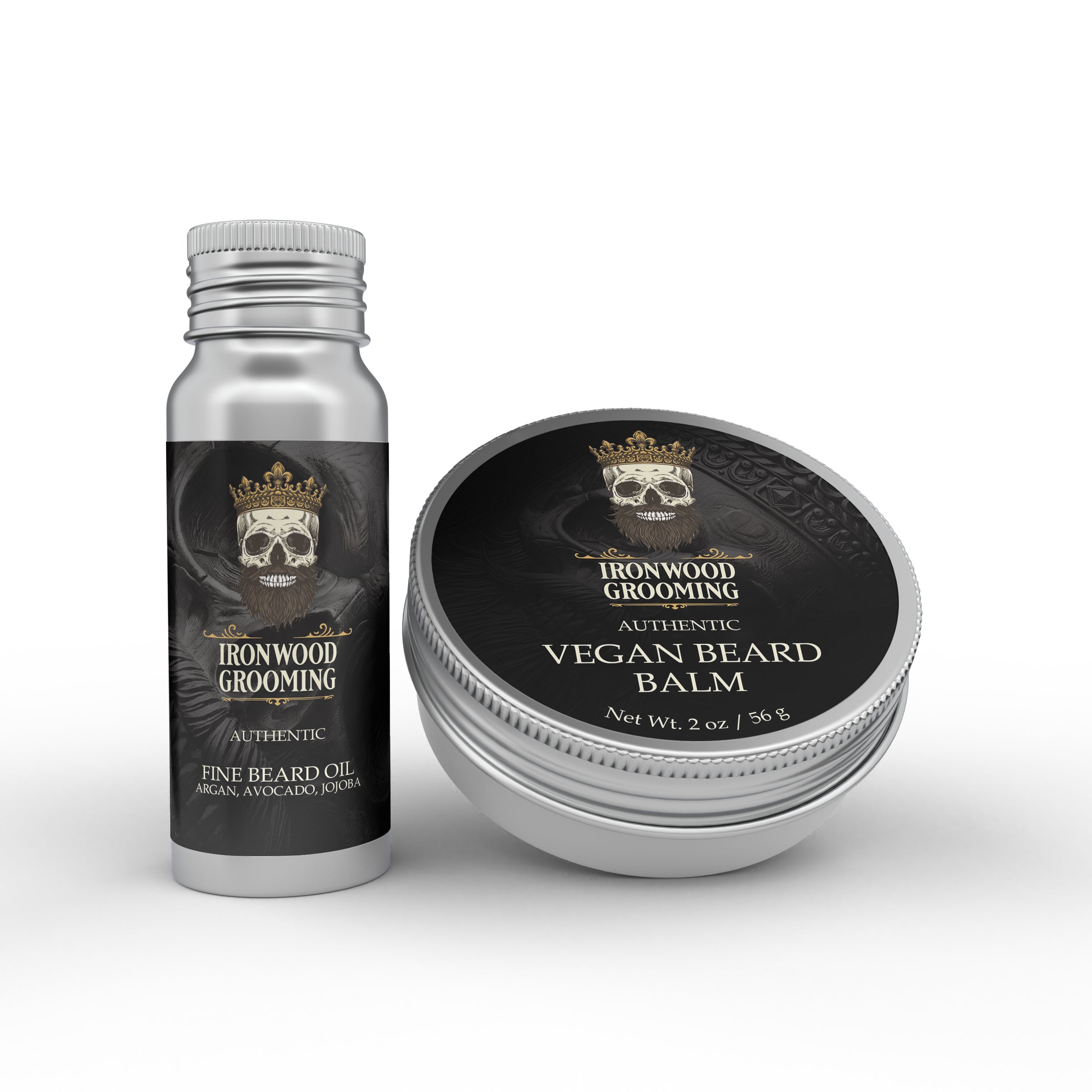
The Vegan Simple Beard Bundle is the clearest example of this standard in action: a complete routine built without animal-derived ingredients, without synthetic filler, and with every ingredient listed where you can actually read it.
Where the Clean Beauty Movement Came From
Clean beauty didn’t start as a marketing category. It started as a reaction. In the early 2010s, a wave of consumer advocacy groups and independent researchers began publishing ingredient databases that let ordinary shoppers look up what was actually in their shampoo or moisturizer for the first time. Before that, ingredient lists existed on packaging, but almost nobody outside a chemistry background could parse them.
Retailers noticed the shift first. Specialty beauty chains began building their own banned-ingredient programs in the mid-2010s, partly out of genuine concern and partly because “clean” sold. That commercial incentive is exactly what turned a consumer-safety conversation into a marketing category almost overnight, and it’s also why the definition splintered instead of consolidating. Every retailer that built a program had a reason to make theirs slightly different from the competition, whether that meant a longer avoid list, a stricter certification requirement, or a different sustainability angle layered on top.
Men’s grooming came to the conversation later than skincare and cosmetics. For years, beard oils and pomades got a pass on ingredient scrutiny that shampoos and lotions didn’t, largely because the market assumed men weren’t reading labels. That assumption is outdated. The same scrutiny beauty shoppers apply now belongs on a beard oil sitting on your face for twelve hours a day.
Clean Beauty and the Environment: More Than Just Your Skin
Clean beauty overlaps heavily with sustainability, even though the two aren’t identical. An ingredient can be perfectly safe for your skin and still carry environmental costs at scale, and that’s the piece a lot of “clean” marketing conveniently skips.
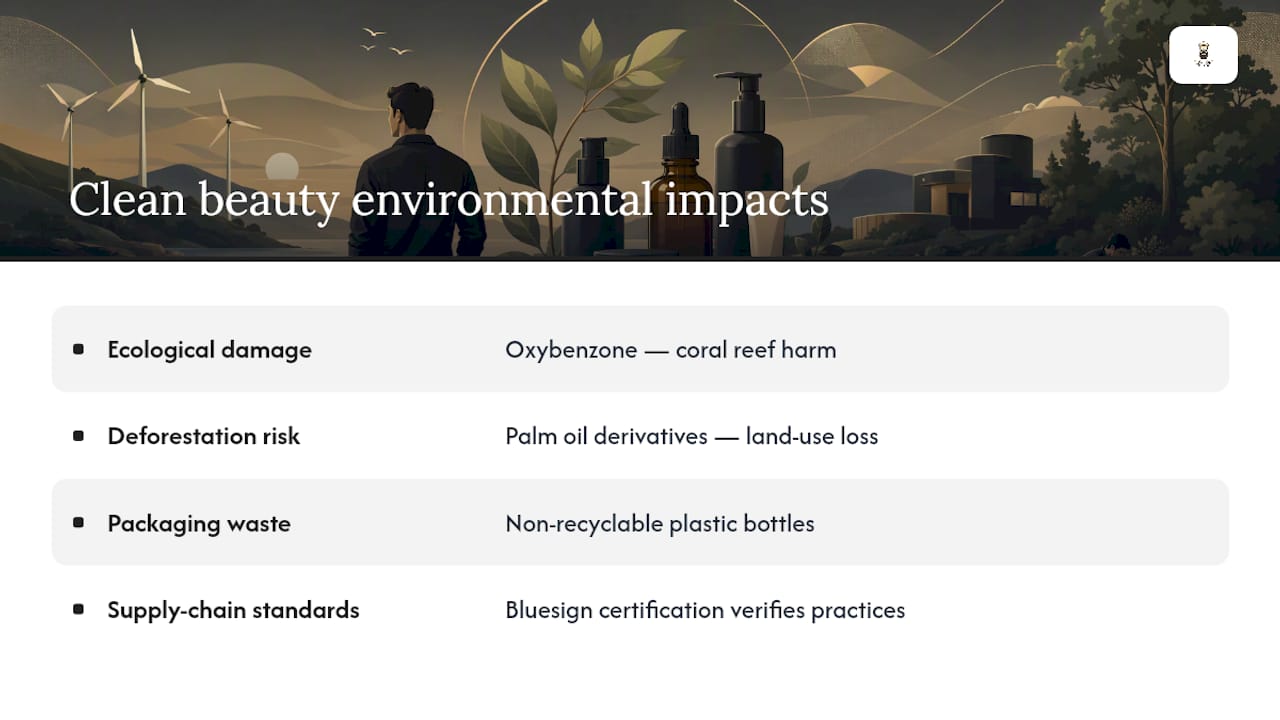
Oxybenzone is the clearest example. Beyond the human health questions covered earlier, the same UV filter has drawn scrutiny for its effects on coral reef ecosystems, which is why several destinations have moved to restrict it in sunscreens sold locally. Palm oil derivatives, another common cosmetic ingredient, raise deforestation and land-use concerns entirely separate from anything about skin safety. Packaging matters too: a “clean” formula in a non-recyclable plastic bottle solves one problem while ignoring another.
Third-party sustainability standards fill part of this gap the way ingredient certifiers fill the safety gap. Programs like Bluesign certification verify environmental and chemical management practices across a supply chain, giving shoppers a documented standard to check rather than a vague “eco-friendly” claim with nothing behind it. If a brand’s clean claim only covers what touches your skin and never mentions sourcing, manufacturing waste, or packaging, you’re getting half the picture.
Is Clean Beauty Worth It? Benefits and Real Limitations
The benefits are genuine for the right person. If you deal with sensitive skin, contact irritation, or a family history of hormone-sensitive conditions, reducing exposure to synthetic fragrance and certain preservatives is a reasonable precaution, not paranoia. Transparency itself is a benefit too: a brand willing to publish its full formula and sourcing practices tends to be a brand worth trusting on other claims as well.
The limitations are just as real, and worth saying plainly. Clean beauty products often cost more, and that premium doesn’t always buy you a meaningfully safer product, especially when the “clean” claim is self-declared with no certification behind it. The category also invites a kind of chemophobia where any ingredient with a complicated name gets treated as dangerous regardless of actual dose or evidence. That instinct isn’t scientific, it’s marketing working exactly as designed. And “natural” framing can backfire entirely, since some botanical ingredients cause more irritation than the synthetic alternatives they replaced.
The honest takeaway: clean beauty is a useful filter, not a guarantee. It narrows your options toward products worth a closer look. It doesn’t replace actually reading the ingredient list.
How to Spot Genuinely Clean Beauty Beyond the Marketing
Marketing language is cheap. Verification is not, and that gap is where you separate real formulation standards from packaging design.
Start by treating every “clean” claim as a promise to be checked, not a fact to be trusted. A published, specific avoid list beats a vague “non-toxic” claim every time, and a third-party certification beats a brand’s own badge every time. Look for brands that name their standard out loud: which ingredients they exclude, why, and where you can verify it independently.
Small-batch production is a quieter signal worth watching for too. Brands making products in smaller runs generally have less financial incentive to cut corners with filler ingredients, because they’re not optimizing for shelf life measured in years or margins measured in fractions of a cent. That doesn’t guarantee anything on its own, but paired with a published ingredient list, it’s a meaningful data point.
Ironwoodgrooming’s guide on identifying vegan beard products walks through this same verification process specifically for beard care, where filler oils and unlisted fragrance compounds are especially common in mass-market products.
An Honest Read on the Clean Beauty Conversation
The research here supports a blunt conclusion: clean beauty is a useful shopping filter and a lousy safety guarantee, and treating it as either extreme gets you into trouble. Conventional advice tends to push readers toward one of two camps: trust every “clean” label at face value, or dismiss the whole category as marketing nonsense. Both miss the actual point.
What the evidence supports is narrower and more useful. Some ingredients, particularly synthetic fragrance and certain preservatives, carry legitimate irritation and allergen risk worth avoiding if you’re sensitive. Other ingredients get flagged mostly because they sound scary, not because the dose you’re exposed to matters much. The reader’s job isn’t to memorize a banned list. It’s to demand the same thing from every brand: a published formula and a verifiable standard behind whatever claim sits on the label.
Prioritize transparency over vocabulary. A brand willing to show you exactly what’s in the bottle, and why, has already told you more than any “clean” sticker ever will.
— Robert
Get Your Beard Routine on a Genuinely Clean Standard
You don’t need to become a chemist to groom with confidence. You need a brand that already published the answers. Ironwoodgrooming builds every formula small-batch, without the filler ingredients or unlisted fragrance compounds that make “clean” claims hard to trust elsewhere, and every product page lists exactly what went into the bottle.
If you deal with coarse beard growth or skin that flares up under stubble, the Vegan Simple Beard Bundle gives you a complete routine built on that same standard: plant-based, cruelty-free, and formulated specifically for the irritation a growing beard causes. For a deeper look at how vegan formulation handles reactive skin specifically, Ironwoodgrooming’s guide to vegan beard care for sensitive skin breaks down exactly which ingredients matter and why.
Check the full ingredient list on the bundle’s product page, compare it against the checklist above, and decide for yourself whether it holds up. That’s the whole point of a genuinely clean formula: it’s built to survive the scrutiny.
This article is general information, not a substitute for advice from a qualified doctor. Consult a qualified healthcare professional about your own circumstances before acting on anything here.
Sources
- What does “clean beauty” mean? New framework gives a path forward
- Prohibited & restricted ingredients in cosmetics | FDA
- FTC Green Guides
- What is clean beauty? — Clean Beauty Coalition
- PubMed indexed study / review (example entry)

