


Beard hydration science is the study of how moisture interacts with the skin and hair beneath your beard to drive healthier growth, softer texture, and better grooming results. Most beard problems, including persistent itch, beardruff, and brittleness, are not beard problems at all. They are skin problems. Understanding that single distinction changes everything about how you care for your beard.
Here is what beard hydration science addresses:
- How sebum moves (or fails to move) from your skin to your hair
- Why the skin barrier beneath your beard breaks down over time
- What internal and external hydration actually do for follicle health
- Which ingredients penetrate the skin versus which ones just coat the surface
- How environmental conditions accelerate moisture loss
The biological players are sebum, water, and the stratum corneum, the outermost skin layer that acts as your moisture barrier. When that barrier stays intact, your beard looks full and feels soft. When it breaks down, no amount of product applied to the hair itself will fix it.
How hydration affects beard hair structure and follicles
Beard hair is dead keratin. The hair shaft itself cannot absorb water or oil in any meaningful biological sense. What actually determines how your beard looks and feels is the condition of the living skin beneath it, specifically the follicle environment and the stratum corneum.
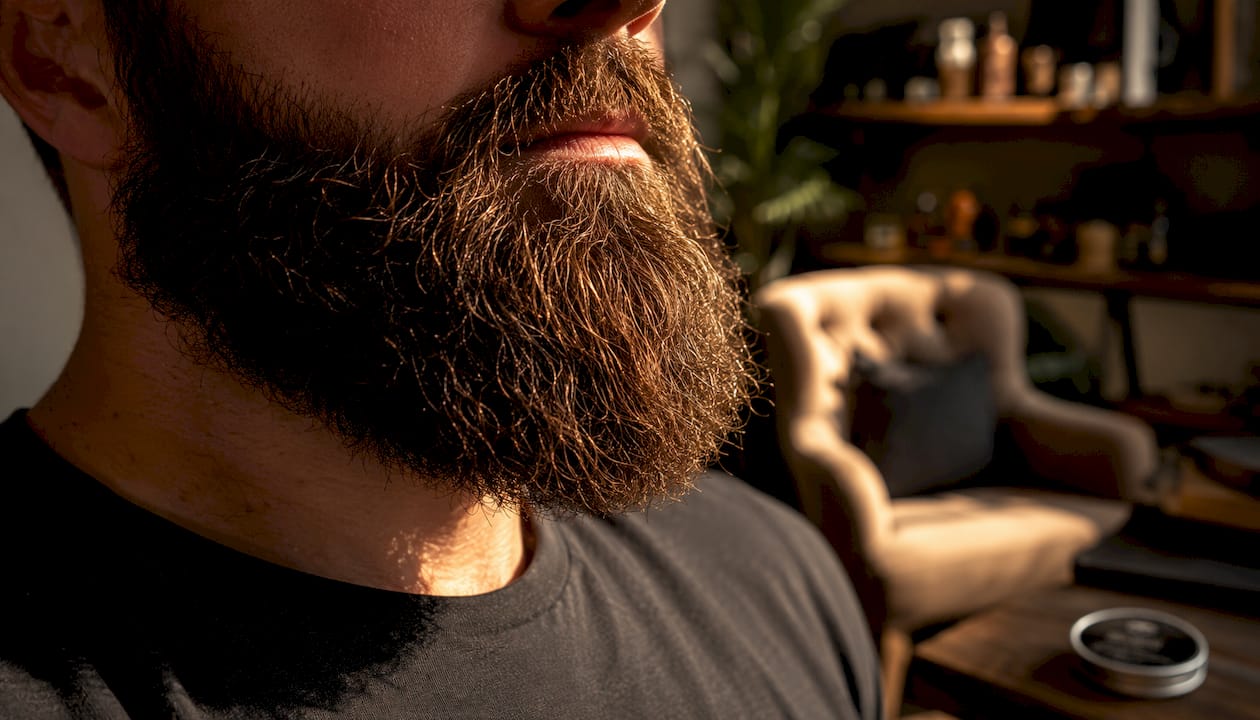
The most important mechanism here is the sebum deprivation phenomenon. Beard hair physically wicks sebum away from the skin surface through capillary action. The longer and denser your beard, the more pronounced this effect becomes. Your skin produces oil, but the beard moves it away before it can protect the skin. Without sebum, the stratum corneum becomes lipid-deficient, transepidermal water loss accelerates, and the skin loses its ability to protect itself.
Bacteria and dead skin cells then form a biofilm around the sebum pathways, blocking new sebum from reaching the surface. The warm, humid environment under a beard accelerates this process. The result is a cycle of dryness, inflammation, and worsening skin barrier damage.
| Characteristic | Hydrated beard skin | Dehydrated beard skin |
|---|---|---|
| Skin texture | Smooth, supple | Flaky, tight, rough |
| Sebum distribution | Even, reaches surface | Blocked by biofilm |
| Beard hair feel | Soft, flexible | Brittle, coarse |
| Common symptoms | None | Itch, beardruff, redness |
| Follicle environment | Stable, well-nourished | Inflamed, lipid-deficient |
Environmental factors compound the problem. Cold, dry air in winter strips moisture faster, and hot water during washing strips natural oils from the skin surface. The optimal wash temperature is warm but not hot. Water that is too hot accelerates transepidermal water loss and increases brittleness.
How hydration shapes beard growth and appearance
Hydration does not make your beard grow faster. Full stop. Beard growth is driven by dihydrotestosterone (DHT) and your genetics. No topical oil has been shown in clinical studies to increase follicle growth rate or fill in patchy spots. Brands that imply otherwise are marketing past the evidence, as confirmed by Healthline’s review of beard oil research.
What hydration does change is the quality and appearance of the beard you already have:
- Well-hydrated hair lies flatter, looks fuller, and reflects light more evenly
- Softened hair shafts resist breakage and split ends
- A healthy skin barrier reduces the inflammation that can disrupt follicle function
- Proper moisture balance makes coarse hair significantly more manageable
“Well-hydrated skin and hair feel softer, itch less, and look healthier.” — Dr. Anthony Rossi, MD, FAAD, board-certified dermatologist, American Academy of Dermatology
That quote captures the practical ceiling of what topical hydration delivers. It improves the condition of what you have. It does not rewrite your genetics. A skin-first approach to beard care focuses on the follicle environment, not the hair fiber, and that is where the real gains live.
Practical beard hydration and grooming tips for healthier beards
The science points to a clear sequence. Applying oil to a blocked skin barrier is like watering a plant through a sealed pot. The order of operations is the mechanism.
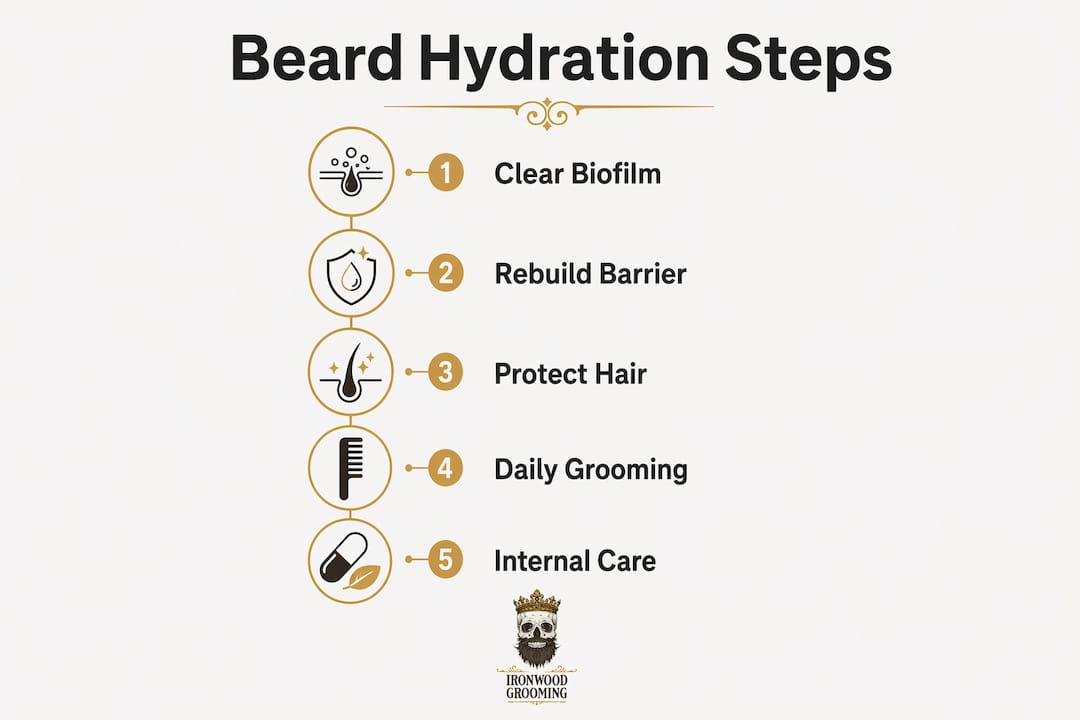
Step 1: Clear the biofilm. Use a product containing lauric acid. Lauric acid is small enough to penetrate the hair structure and disrupts bacterial biofilm through its antimicrobial properties, reopening the sebum pathway to the skin surface. Ironwoodgrooming’s Ultra Soft Beard Wash supports this step by gently cleansing without stripping the skin’s natural oils.
Step 2: Rebuild the skin barrier. Omega-7 fatty acids integrate into the cleared stratum corneum rather than sitting on top of it. This is the difference between lasting hydration and temporary surface softness.
Step 3: Protect the hair shaft. For beards longer than three inches, stearic acid and oleic acid coat the hair shaft and prevent the brittleness caused by wind, friction, and UV exposure.
Pro Tip: Massage oil into the skin first, then brush outward through the beard. Oil applied only to the hair surface provides temporary softness but leaves the skin beneath untreated.
Diet and internal hydration matter more than most men realize. Foods rich in omega-3 fatty acids, including salmon, walnuts, and flaxseed, directly support the follicle environment and skin moisture balance. Dehydration at the cellular level shows up in your beard before it shows up anywhere else.
The American Academy of Dermatology recommends matching your moisturizer to your skin type: beard conditioner for acne-prone skin, beard oil for normal to dry skin, and fragrance-free non-comedogenic moisturizer for sensitive skin. Getting this match right reduces irritation and improves absorption. You can also explore beard products for different skin types to find formulations suited to your specific needs.
Common hydration mistakes to avoid:
- Washing with water that is too hot, which strips sebum and accelerates dryness
- Applying oil without first clearing dead skin buildup, which leads to a greasy beard with no itch relief
- Skipping moisturizer on oily or acne-prone skin, which worsens the skin barrier over time
- Treating beard itch with more hair-focused product rather than addressing the underlying skin dryness
What dermatologists and research say about beard hydration science
The clinical evidence on beard hydration science reinforces the skin-first model consistently. A published study in the Journal of Multidisciplinary Applied Natural Science found that a formulation of high-antioxidant natural oils, including olive, jojoba, argan, apricot, macadamia, soybean, and avocado, produced over 12% increase in beard growth rate by week 2 and nearly 50% increase in density by week 4 compared to baseline. The study involved adult men and used advanced imaging techniques for measurement. These results reflect the nourishing effect of antioxidant-rich oils on the follicle environment, not a hormonal growth trigger.
Dermatologists consistently emphasize treating the skin beneath the beard, not just conditioning the hair fibers. Ironwoodgrooming’s approach to skin barrier restoration aligns directly with this clinical consensus. Persistent itch that does not respond to standard beard oils is almost always a sign that the skin barrier is blocked, not that you need more product on the hair.
Key research-backed principles:
- Lauric acid is the only common fatty acid small enough to penetrate the hair shaft and disrupt biofilm at the skin surface
- Omega-7 lipids rebuild the stratum corneum from within, providing lasting relief rather than surface-level softness
- Overapplication of oils without addressing biofilm creates greasiness without resolving itch, confirming that skin clearance must come first
- Natural antioxidant oils outperform synthetic conditioners in clinical nourishment studies because of their fatty acid profiles and biocompatibility with human skin lipids
For men with coarse beards or persistent irritation, Ironwoodgrooming’s Uplifting Vegan Beard Butter and Ivow Vegan Beard Butter are formulated to deliver deep, lasting hydration without synthetic fillers, built on exactly these principles.
Key Takeaways
Beard hydration science proves that lasting moisture, softness, and itch relief come from repairing the skin barrier beneath the beard, not from conditioning the hair itself.
| Point | Details |
|---|---|
| Skin barrier is the target | Beard problems like itch and beardruff are skin problems caused by sebum deprivation and biofilm buildup. |
| Sequence drives results | Clear biofilm with lauric acid first, then rebuild with omega-7, then protect the hair shaft with stearic and oleic acids. |
| Growth is hormonal | No topical oil increases beard growth rate or fills patches; hydration improves appearance, not genetics. |
| Antioxidant oils show clinical results | Natural oil formulations produced a nearly 50% density increase by week 4 in a published clinical study. |
| Diet supports hydration | Omega-3-rich foods directly support the follicle environment and skin moisture balance from within. |
Recommended
- Why Your Beard Needs Daily Brushing: A Coarse Beard Guide – Ironwood Grooming
- Beard Moisturizing Routine for Thick Hair: 2026 Guide – Ironwood Grooming
- How to Moisturize a Coarse Beard: The Layering Method | Ironwood Grooming
- THE SCIENCE‑VERIFIED IRONWOOD SKIN‑BARRIER BEARD IRRITATION ARTICLE – Ironwood Grooming

