


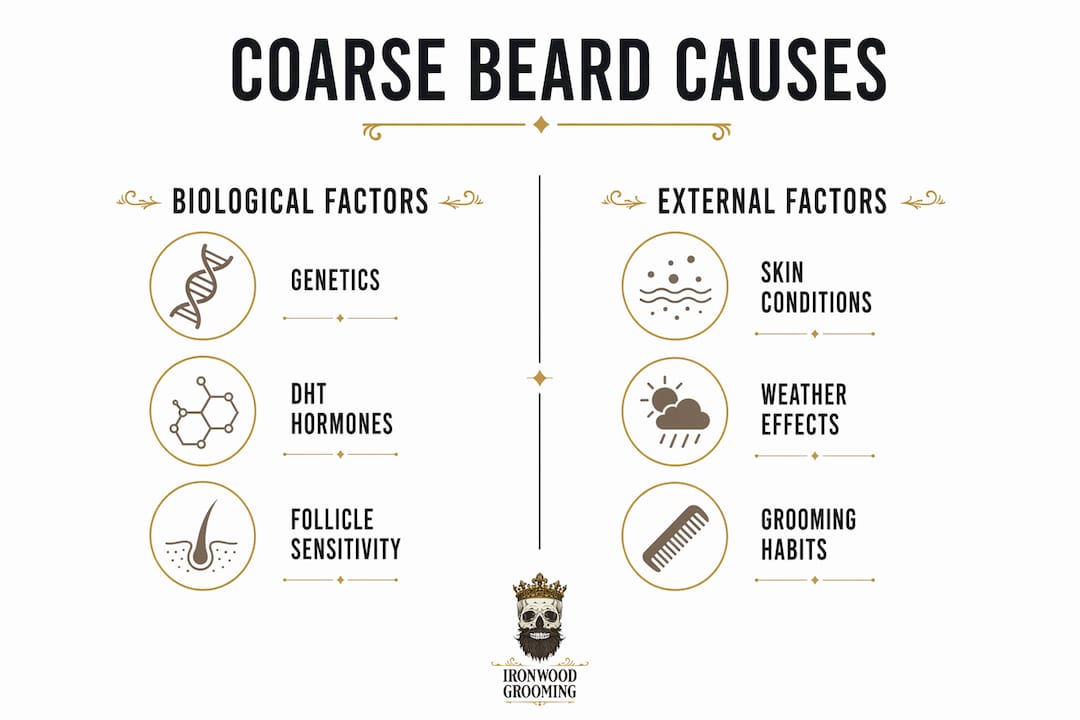
Coarse beard hair is not a grooming failure. It’s a biological outcome — the direct result of how your follicles respond to androgens, especially dihydrotestosterone (DHT). Beard hair averages around 0.1 mm in diameter, roughly twice that of scalp hair, a difference documented in Robbins’ research on hair fiber structure. That thickness is encoded in your genetics and shaped by hormone signaling. No product can override that biology. What grooming can do is work with it.
Understanding what actually causes coarse beard hair — at the level of follicle biology, skin health, and daily habits — is the foundation for a routine that produces real results.
The Biology Behind Coarse Beard Hair
Beard hair is coarser than scalp hair because of how DHT interacts with facial follicles. DHT is a potent androgen derived from testosterone. Research by Sawaya & Price shows that facial follicles respond to DHT by producing thicker, more rigid hair shafts, while scalp follicles respond differently — high DHT sensitivity at the scalp is associated with thinning, while the same sensitivity at the face produces denser growth.
Genetics determine how strongly your follicles respond to DHT. Genome‑wide association studies, including work by Adhikari et al., have identified multiple genetic regions associated with beard growth characteristics, with the androgen receptor gene being the most influential. Two men with identical hormone levels can have dramatically different beard textures based on receptor sensitivity alone.
How DHT Shapes Your Follicle
When DHT binds to a facial follicle with high receptor sensitivity, the follicle produces a wider, more rigid hair shaft with a thicker cuticle layer. That rigidity is what you feel when your beard scratches your skin or snags on fabric. It’s not a flaw — it’s your biology doing exactly what it was designed to do.

Beard vs. Scalp Hair: Key Structural Differences
| Trait | Beard hair | Scalp hair |
|---|---|---|
| Average diameter | ~0.1 mm | ~0.05–0.07 mm |
| Androgen sensitivity | High (DHT‑responsive) | Low to moderate |
| Follicle depth | Deeper | Shallower |
| Curl tendency | Higher | Lower |
| Cuticle thickness | Thicker | Thinner |
Pro tip: If your beard feels noticeably coarser in your mid‑20s than it did at 18, that’s normal. Androgen receptor activity tends to increase with cumulative hormone exposure over time — not because DHT “accumulates,” but because follicles become more responsive.
How Skin Conditions Make Coarse Beard Hair Feel Worse
Skin health directly affects how your beard feels — and this is where many men misdiagnose the problem. Seborrheic dermatitis, a common inflammatory condition driven by Malassezia yeast, produces flakes, redness, and itching beneath the beard. Research by Gupta & Nicol shows that inflammation disrupts the skin barrier and increases turnover, which makes beard hair feel rougher and more brittle.
The distinction matters. Coarseness from follicle biology is consistent. Coarseness worsened by inflammation feels itchy, patchy, and reactive. If two weeks of consistent moisturizing doesn’t reduce roughness or itching, a skin condition may be involved. Persistent flaking often signals seborrheic dermatitis — and that requires a different approach than simple hydration.
Common Skin Conditions Affecting Beard Texture
| Condition | Key symptoms | Effect on beard hair |
|---|---|---|
| Seborrheic dermatitis | Flaking, redness, itching | Increases roughness and irritation |
| Contact dermatitis | Rash, burning, swelling | Makes hair feel coarser near irritated skin |
| Dry skin (xerosis) | Tightness, flaking | Mild roughness, improves with moisturizing |
| Folliculitis | Tender bumps around follicles | Creates irregular texture |
Pro tip: If your beard itch doesn’t improve after two weeks of consistent moisturizing, see a dermatologist. Ketoconazole shampoos — supported by multiple RCTs — are effective for seborrheic dermatitis, but standard grooming products are not.
Grooming Habits That Worsen Beard Texture
Your daily habits have a measurable impact on how coarse your beard feels — independent of your biology. Cold weather and indoor heating reduce skin barrier function, pulling moisture from both skin and hair. Harsh soaps strip natural oils. Over‑brushing damages the cuticle, creating split ends and roughness. Robbins’ work on hair fiber mechanics shows that once the cuticle is compromised, the hair shaft becomes irregular and catches on itself — exactly the “scratchy” feel men describe.
- Washing with body soap or scalp shampoo. These formulas are too harsh for facial skin and beard hair.
- Skipping moisturizer after washing. Beard hair loses moisture faster than scalp hair.
- Brushing aggressively on a dry beard. Always apply oil or balm first to reduce friction.
- Ignoring environmental exposure. Cold air, wind, and dry heat all worsen roughness.
- Using dull scissors or clippers. Dull blades crush the hair shaft, causing frayed ends.
How to Soften Coarse Beard Hair Without Fighting Your Biology
You can’t change your genetics or your androgen sensitivity — but you can absolutely change how your beard feels. The right routine conditions the cuticle, supports the skin beneath, and reduces moisture loss.
- Wash with a beard‑specific cleanser 2–3 times per week. Overwashing strips sebum; underwashing allows buildup to stiffen the hair.
- Apply beard oil immediately after washing. Damp hair doesn’t “absorb” oil — but water reduces friction, allowing oils like jojoba and argan to spread more evenly across the cuticle.
- Use a beard butter or balm for deeper conditioning. Butters coat the cuticle and help retain moisture longer than oils alone.
- Brush with a boar bristle brush after applying product. This distributes oils evenly and trains the hair to lie flat.
- Trim every 2–4 weeks with sharp tools. Clean cuts prevent frayed ends from worsening texture.
- Support follicle health through diet. Almohanna et al. show zinc deficiency is associated with hair brittleness. Biotin deficiency is also linked to brittle hair, though supplementation only helps if deficient.
- Adjust your routine seasonally. Winter requires heavier conditioning; summer may require lighter oils.
Key Takeaways
| Point | Details |
|---|---|
| Biology sets the baseline | DHT and androgen receptor sensitivity determine natural coarseness. |
| Genetics control texture | Multiple genetic regions influence beard thickness and density. |
| Skin conditions worsen roughness | Seborrheic dermatitis adds inflammation and itching. |
| Habits matter | Harsh soaps, over‑brushing, and dryness all increase roughness. |
| Conditioning improves softness | Oils and butters condition the cuticle and reduce moisture loss. |
The Honest Truth Most Men Miss
Your beard’s texture is a direct expression of your androgen profile and genetic makeup. That’s not a defect — it’s part of who you are. The biggest mistake men make is chasing softness instead of consistency. Beard biology doesn’t respond to short bursts of effort. It responds to daily discipline.
The second mistake is ignoring skin health. A coarse beard sitting on inflamed skin will always feel worse than it should. Treating the skin beneath the beard is the foundation of every good routine.
Genetics and DHT set your ceiling. Grooming raises your floor. The goal isn’t to make your beard feel like scalp hair — it’s to make it feel like the best version of itself.
— Roberto, Ironwood Grooming
Keep Reading
- Why Your Beard Needs Daily Brushing: A Coarse Beard Guide
- Sebum and Beard Health: What Every Man Should Know
- Sweat-Proof Beard Hold: How to Keep Your Beard Fresh Through Workouts and Heat
Part of the Ironwood Regimen Series
New to beard care? Start here.
The Beginner Beard Regimen is the complete start-here guide — cleanse, hydrate, seal — for guys building their first real routine.
See the Beginner Regimen →
