


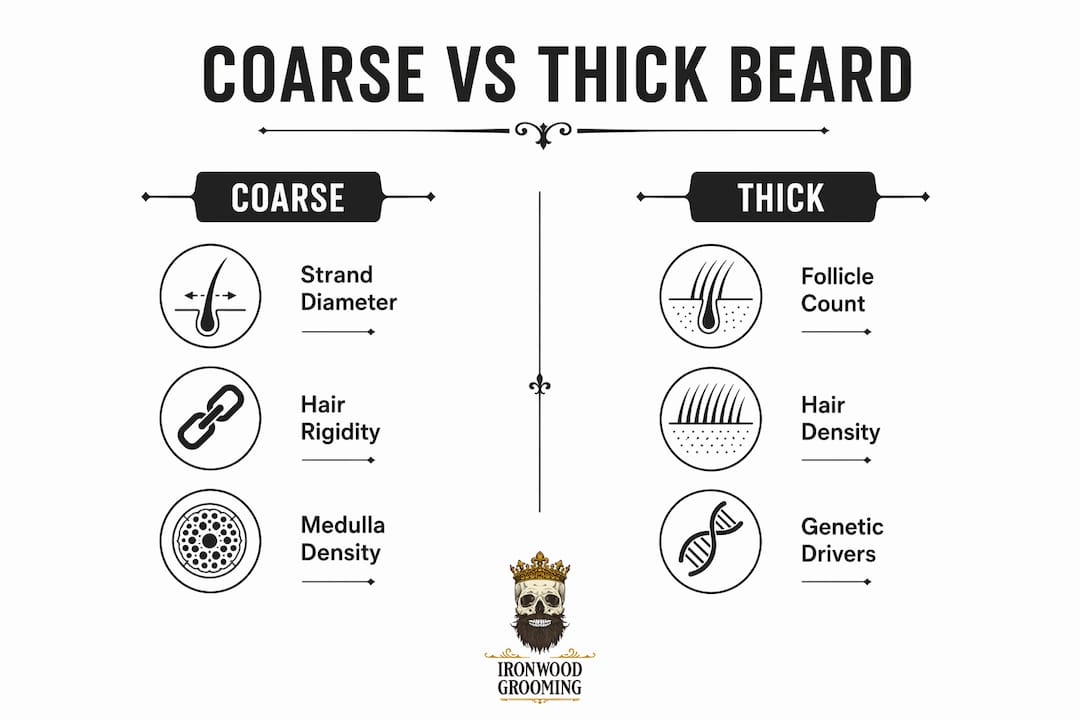
Coarse and thick are not the same thing. Coarse refers to the diameter and texture of each individual strand. Thick refers to how many hairs grow per square centimeter of skin. You can have a coarse beard that’s sparse, a thick beard with fine strands, or both traits stacked together. Each combination demands a different routine, different tools, and different styling instincts.
- Coarse = strand diameter and rigidity (individual hair texture)
- Thick = follicle density (how many hairs grow per area)
- You can be coarse, thick, both, or neither
- Each trait drives different grooming choices
Ironwoodgrooming builds its small-batch formulas specifically around these distinctions, because a product that works for fine, dense hair often fails a coarse, sparse beard entirely.
Table of Contents
- How to tell whether your beard is coarse, thick, both, or neither
- The biology behind coarse and thick beards
- How coarse vs thick affects appearance and style choices
- Daily, weekly, and monthly routines for coarse and thick beards
- Common mistakes men make with coarse and thick beards
- When to see a barber versus a dermatologist
- Key Takeaways
- The part most guides get wrong about beard type
- The right tools for coarse and thick beards from Ironwoodgrooming
- Useful sources and further reading
How to tell whether your beard is coarse, thick, both, or neither
Self-assessment takes about two minutes. No tools required.
Tactile checks (coarseness):
- Pull a single strand between your thumb and forefinger. Coarse hair feels stiff, wiry, or prickly. Fine hair bends easily and feels almost silky.
- Run your palm across your beard. Coarse beards feel rough and substantial. Fine beards feel soft even at the same length.
Visual checks (density/thickness):
- At stubble length (under half an inch), look for skin showing through. A thick beard casts a shadow with almost no visible skin. A sparse beard shows patches even when strands are coarse.
- At one to two inches, a thick beard holds a shape on its own. A sparse beard, regardless of strand texture, tends to lie flat or separate.
Quick density reference: Grooming research commonly describes a typical range of terminal hairs per square centimeter that many men associate with a “thick” beard. Below that, you’re working with moderate or sparse coverage regardless of how each strand feels.
Pro Tip: Re-check your beard type after four weeks of consistent oiling and conditioning. Hydrated coarse strands lie flatter and feel softer, which can make a sparse beard look denser than it actually is. Don’t confuse improved manageability with a change in actual density.
The biology behind coarse and thick beards
Understanding what drives each trait tells you which problems grooming can fix and which ones it cannot.
What makes a strand coarse: According to follicle anatomy research, coarse beard hair typically features a denser or continuous medulla (the innermost layer of the hair shaft) and an elliptical cross-section rather than a round one. That elliptical shape increases rigidity and resistance, which is why coarse strands feel stiff and hold their direction even when you try to train them otherwise. The cuticle layers on coarse hair are also more pronounced, which contributes to the rough, textured feel.
What drives density: DHT and genetic sensitivity are the primary drivers of follicle count and distribution. DHT converts vellus (fine, barely visible) hairs into terminal (full, pigmented) hairs. Men with higher androgen sensitivity in their facial follicles tend to develop denser beards. The role of genetics in follicle count and androgen response is largely fixed at birth.
| Trait | Biological Driver | Changeable with Grooming? |
|---|---|---|
| Strand coarseness | Medulla density, elliptical cross-section | Partially (hydration softens; structure stays) |
| Beard density | Follicle count, DHT sensitivity, genetics | No (topicals cannot add new follicles) |
What grooming can and cannot do: Conditioning and oiling improve coarse strand manageability significantly. They cannot change your follicle count. If your beard is sparse, no oil or balm will create density. What they will do is make every strand you have perform better.
How coarse vs thick affects appearance and style choices
Coarse strands give body and visual weight at shorter lengths. A man with coarse hair and moderate density can look like he has more beard than he does, because each strand carries presence. That’s an advantage when you want a short, structured look without waiting months for length.
Dense beards fill gaps and create coverage even when individual strands are finer. The visual effect is fullness and shadow, which reads as a strong, settled beard from a distance.
Style do’s and don’ts by trait:
Coarse beard:
- Do: short boxed beards, controlled stubble, tapered shapes that use the natural body of each strand
- Do: style a short beard to capitalize on the built-in structure coarse hair provides
- Don’t: force soft, wispy styles that fight the strand’s natural rigidity
- Don’t: let length grow past the point where weight causes the beard to separate or look unkempt
Thick/dense beard:
- Do: tapered or rounded shapes that avoid a blocky silhouette
- Do: use length strategically to complement your face shape (longer for round faces, shorter for oblong)
- Don’t: leave a dense beard unshaped. Dense beards look unkempt quickly without regular structure
- Don’t: carve sharp cheek lines on a very dense beard. Regrowth shows within hours and the line looks ragged by mid-day
Pro Tip: Square faces benefit from rounded beard edges that soften the jawline. Round faces gain definition from length at the chin. These rules apply regardless of whether your beard is coarse or thick, but they matter more when density or strand weight exaggerates your natural face shape.
Daily, weekly, and monthly routines for coarse and thick beards
Coarse beard routine
Daily: Cleanse with a gentle, sulfate-free beard wash (two to three times per week maximum; water rinse on off days). Apply a lightweight beard oil while the beard is still slightly damp. The layering method for coarse beards works best: oil first to penetrate the strand, then a small amount of balm to seal and hold. Brush with a firm-bristle brush to train direction and distribute product.
Weekly: Deep condition with a beard butter or conditioning mask. Check the skin underneath for dryness or early ingrown hairs.
Monthly: Shape with a trimmer or visit a barber. Assess whether your oil is still absorbing or sitting on top (a sign you need a lighter carrier).
Thick/dense beard routine
Daily: Dense beards need fast-absorbing oils like jojoba or grapeseed. Heavy carriers like coconut or castor oil tend to sit on the surface of dense beards, leaving a greasy finish without reaching the skin. Apply oil in sections, working it down to the skin with your fingers before combing through.
Weekly: Condition thoroughly. Use a beard conditioning routine that includes a rinse-out conditioner. Trim stray hairs to maintain shape.
Monthly: Full shaping session. Use a butter mask as a deep treatment. Check your trimmer.
Pro Tip: Application order matters: cleanse, then oil, then brush, then style. Reversing the order traps product residue against the skin and causes buildup under dense beards.
| Trimmer Type | RPM Range | Best For |
|---|---|---|
| Standard consumer rotary | — | Fine to medium beards |
| Professional linear motor | — | Thick and coarse beards |
| Corded clipper | — | Very dense, fast-growing beards |
Professional-grade trimmers handle thick and coarse hair without stalling or pulling. If your current trimmer snags, that’s the first thing to fix.
Common mistakes men make with coarse and thick beards
- Using a weak trimmer. A standard consumer trimmer stalls on dense or coarse beards. Upgrade to a professional linear-motor trimmer or corded clipper.
- Applying heavy oils to dense beards. Coconut and castor oil sit on the surface of thick beards and never reach the skin. Switch to jojoba, argan, or grapeseed.
- Skipping oil on coarse beards. Coarse strands dry out faster than fine ones. Regular oiling reduces itch, dryness, and brittleness.
- Forcing the wrong style. Trying to make coarse hair look soft and flowing usually fails. Work with the strand’s natural body instead.
- Carving sharp lines on dense beards. Regrowth is visible within a day. Softer, tapered lines hold longer.
- Over-washing. Washing daily strips the natural oils that coarse hair depends on for flexibility.
Quick fix for a tangled coarse beard: Work a small amount of lightweight oil through the beard dry, wait two minutes, then comb from the ends upward with a wide-tooth comb before working back down to the roots. Never yank from the root on dry, unlubricated coarse hair.
When to see a barber versus a dermatologist
Maintenance timeline:
- Months 1–4: Establish length and coverage. Expect patchiness and uneven texture. Resist trimming too aggressively.
- Monthly: Shaping for dense beards. Dense growth needs structure on a consistent cadence.
- Weekly: Light trims for coarse, fast-growing beards that lose shape quickly.
| Beard Type | Shaping Cadence | Trimming Cadence |
|---|---|---|
| Coarse, moderate density | Every 3–4 weeks | Weekly edge cleanup |
| Thick/dense, any texture | Every 2–3 weeks | Weekly stray-hair trim |
| Both coarse and thick | Every 2–3 weeks | Weekly |
See a barber when: you want a new shape, your lines are uneven, or you’re unsure which style suits your face and density.
See a dermatologist when: you have persistent ingrown hairs that bleed or scar, ongoing skin inflammation under the beard, or noticeable patchy hair loss that wasn’t there before. These are not grooming problems. A barber cannot fix folliculitis or alopecia barbae.
Key Takeaways
Coarse means strand texture; thick means follicle density. Each trait requires a distinct routine, and confusing them leads to the wrong products, wrong tools, and wasted effort.
| Point | Details |
|---|---|
| Coarse vs thick defined | Coarse = strand diameter and rigidity; thick = follicle density. |
| Self-assessment method | Pinch a single strand for texture; check skin visibility at stubble length for density. |
| Top grooming change for coarse | Apply lightweight oil daily; use a professional-grade trimmer that won’t snag. |
| Top grooming change for thick | Switch to fast-absorbing oils (jojoba, grapeseed); shape every 2–3 weeks to prevent unkempt growth. |
| Ironwoodgrooming tools | The Viking Beard Comb, Tiger Wood Stainless Beard Pick, and Raven Beard Comb are built for coarse and thick beards. |
The part most guides get wrong about beard type
Most beard content treats coarse and thick as synonyms, then gives one-size-fits-all advice that works for neither. The real problem is that men with coarse, sparse beards follow dense-beard routines and wonder why their skin stays dry. Men with thick, fine-stranded beards follow coarse-beard advice and end up with product buildup and clogged pores.
The distinction also matters for realistic expectations. Genetics and DHT set your follicle count. No oil, balm, or supplement changes that. What you can change is how well each strand performs: its flexibility, its moisture retention, and how well it holds a shape. That’s where the right routine and the right tools make a real difference.
Three starter tips for this week: first, do the single-strand pinch test and the skin-visibility check to confirm which trait you’re actually dealing with. Second, swap any heavy carrier oil for jojoba if you have a dense beard. Third, if your trimmer pulls or stalls, that’s your sign to upgrade before your next shaping session.
The right tools for coarse and thick beards from Ironwoodgrooming
Most grooming problems with coarse and thick beards come down to one thing: the wrong tool for the job. Ironwoodgrooming’s handcrafted combs and picks are built specifically for men who need real performance from their gear.
The Viking Beard Comb is a sturdy wooden comb designed to detangle and distribute oil evenly through coarse or thick beards without static or breakage. Use it daily after oiling to train direction and work product to the skin.
The Tiger Wood Stainless Beard Pick lifts dense beards and shapes volume without tugging. It’s the tool for thick beards that need definition and lift before styling. Work it through a damp, oiled beard to separate strands and build shape.
The Raven Beard Comb handles finishing work: smoothing coarse strands and locking in a clean, structured look on shorter styles. Fine-toothed and durable, it’s the last step in a daily routine for men who want a sharp result without fighting their beard.
All three are small-batch, made without shortcuts. Browse the full lineup and find the right tool for your beard type at Ironwoodgrooming.
Useful sources and further reading
- Why Are Beard Hairs So Thick and Coarse? — Biology Insights — Follicle anatomy, medulla structure, and DHT’s role in beard development.
- Beard Growth Science — Gillette US — Practical guidance on conditioning, oiling, and reducing irritation.
- The Role of Genetics in Baldness — Glasgow Hair Transplant Clinics — Clinical overview of androgen sensitivity and follicle response.
- Coarse Beard Grooming Routine for 2026 — Ironwoodgrooming — Step-by-step routine tuned specifically for coarse beard hair.
- Beard Moisturizing Routine for Thick Hair — Ironwoodgrooming — Dense-beard hydration protocol with product layering guidance.
- What Causes Coarse Beard Hair — Ironwoodgrooming — Deep dive into the biological and environmental causes of coarse beard texture.
Recommended
- Beard Training for Coarse, Latino, or Mixed-Texture Beards | Ironwood Grooming
- How to Moisturize a Coarse Beard: The Layering Method | Ironwood Grooming
- Beard Butter vs. Beard Balm: What’s the Difference? | Ironwood Grooming
- Best Beard Comb for Your Beard Type: Stainless Steel, Wood & More | Ironwood Grooming

