


Coarse, Latino, and mixed-texture beards are not harder to grow. They are harder to train with the wrong method. Generic beard advice is written for fine, straight hair. If your beard is thick, wiry, curly at the base, or grows in multiple directions at once, that advice will fail you — not because you are doing it wrong, but because the method was never built for your hair type. This is the version that is.
Why Coarse and Mixed-Texture Beards Are Different
Coarse beard hair has a wider diameter than fine hair, which means it is stiffer, more resistant to direction, and slower to absorb moisture. Latino and mixed-texture beards often combine multiple curl patterns in the same beard — straight at the cheeks, wavy at the jaw, tight curls at the chin and neck. That variation is not a problem to fix. It is a characteristic to work with.
The challenges that come with this hair type are specific:
- Frizz and flyaways are more pronounced because the hair shaft does not lie flat naturally.
- Dryness sets in faster because coarse, curly hair has more surface area and the natural sebum from your skin travels slower down a curved shaft than a straight one.
- Direction training takes longer because the hair has stronger memory and more resistance to change.
- Patchiness looks more visible because curly hair clumps rather than spreading evenly across the face.
None of these are permanent. All of them respond to the right routine applied consistently.

The Training Method for Coarse and Mixed-Texture Beards
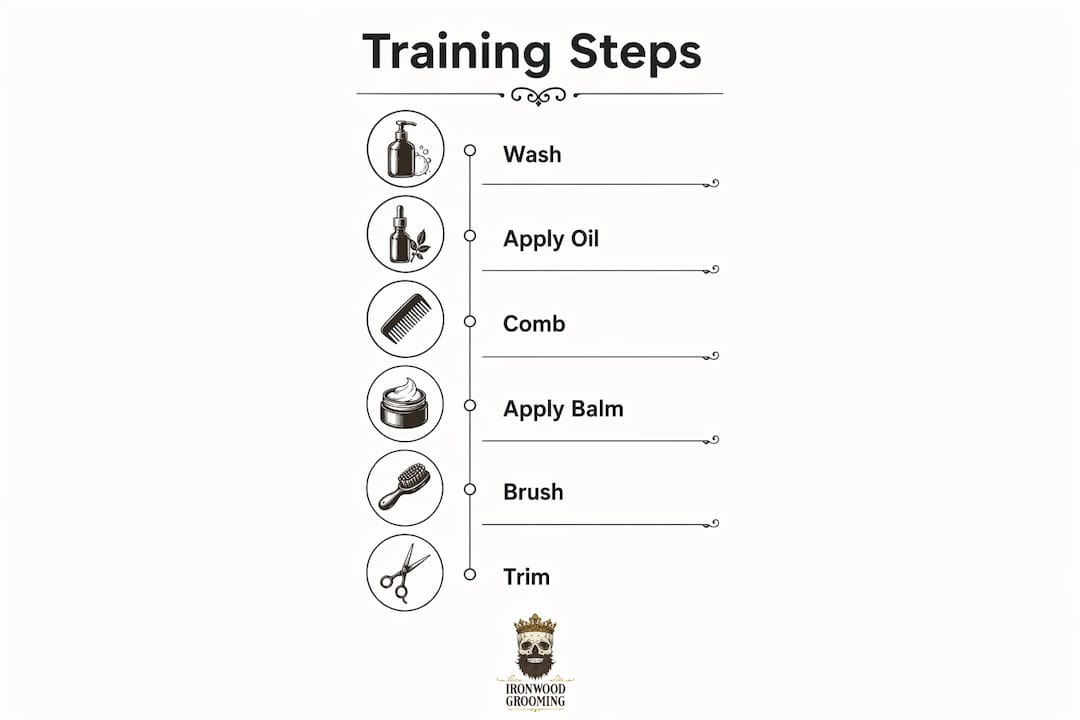
The sequence is the same as any beard training routine — wash, oil, comb, brush, balm — but the tools, products, and technique at each step are different for coarse and mixed-texture hair.
Step 1: Wash with a moisturizing beard cleanser
Coarse hair needs moisture more than it needs cleansing. Wash two times per week maximum. Three if you work outdoors or sweat heavily. Use a beard wash with conditioning agents — not a clarifying formula. On non-wash days, rinse with warm water only. Overwashing a coarse beard strips the little natural oil it has and makes frizz significantly worse.
Step 2: Apply oil immediately on damp hair
This step is more critical for coarse hair than any other type. The window between towel-dry and fully dry is when the hair cuticle is most open and oil absorbs deepest. Miss that window and the oil sits on the surface instead of penetrating. Use more than you think you need — 4 to 8 drops for a short beard, 8 to 12 for a medium or long one. Work it in from root to tip with your fingers, pressing into the skin beneath. Our beard oils are built on argan and jojoba bases specifically because they match the skin’s natural sebum and absorb into coarse hair without leaving a greasy film.
Step 3: Detangle with a wide-tooth comb, not a brush
Start with a wide-tooth comb, not a boar bristle brush. Coarse and curly hair tangles at the root. Forcing a brush through it before detangling causes breakage and frizz. Work the comb through in sections — cheeks first, then jaw, then chin and neck — using slow, deliberate strokes downward. Do not rush this step. This is where direction training actually happens for coarse hair.
Step 4: Follow with a boar bristle brush
Once detangled, use a boar bristle brush to smooth the surface and lock in the directional pattern. The bristles distribute the oil you applied in step 2 from root to tip and flatten the cuticle. Brush downward along the jaw and chin. For mixed-texture beards with curl at the neck, brush downward and slightly inward to encourage the hair to follow the jawline rather than curl outward. Read more on why daily combing and brushing matters for long-term beard health.
Step 5: Seal with a heavier balm or beard butter
Standard beard balm works for most hair types. For coarse and mixed-texture beards, a beard butter often performs better — it has a higher shea or cocoa butter content that provides deeper conditioning and stronger hold without the stiffness of a wax-heavy balm. Apply after brushing, working it through with your fingers and then smoothing with the brush again to set the direction. For a full breakdown of when to use balm versus butter, read Beard Butter vs. Beard Balm: What’s the Difference and Which One Wins?
How Long Training Takes for Coarse Hair
Expect longer than average. Fine, straight beards can show directional training results in four to six weeks. Coarse and mixed-texture beards typically take eight to twelve weeks of consistent daily grooming before the hair holds its trained direction without heavy product. That is not a flaw. That is the nature of a stronger, denser hair shaft.
What you will notice first, around weeks two to four, is reduced frizz and improved softness. The directional hold comes later. Do not judge the method by week two results.
Tool Selection for Coarse and Mixed-Texture Beards
| Tool | Coarse/Mixed-Texture Recommendation | Why |
|---|---|---|
| Comb | Wide-tooth, stainless steel or wood | Moves through dense, tangled hair without snagging or static |
| Brush | Boar bristle, firm grade | Distributes oil and smooths the cuticle on coarse hair shafts |
| Oil | Argan + jojoba base, unscented or lightly scented | Penetrates coarse hair without buildup; mimics natural sebum |
| Balm or butter | Shea or cocoa butter-heavy formula | Provides hold and deep conditioning without stiffness |
Plastic combs create static in coarse hair and snag on tight curl patterns. Stainless steel or wood combs glide through without pulling. If you are not sure which comb fits your beard density and texture, the Stainless Steel vs. Plastic vs. Wood Comb guide breaks it down by hair type.
Common Mistakes with Coarse and Mixed-Texture Beards
- Using too little product. Coarse hair needs more oil and balm than fine hair. If your beard still feels dry after oiling, you are under-applying.
- Brushing before detangling. Always comb first. Brushing tangled coarse hair causes breakage and makes frizz worse, not better.
- Expecting straight-hair results. A coarse or curly beard trained well will look controlled and intentional — not flat and straight. Work with the texture, not against it.
- Quitting during the awkward phase. Weeks two through five are the hardest. The beard looks uneven, the curl pattern is inconsistent, and the training has not taken hold yet. This is the phase most men quit. Push through it. The 6 beginner mistakes article covers exactly why this phase feels worse than it is.
- Skipping the butter or balm. Oil alone is not enough hold for coarse hair. You need the sealing layer to lock in direction and prevent reversion throughout the day.
What I Tell Every Man with a Coarse Beard
The men who struggle most with coarse and mixed-texture beards are the ones who follow advice written for someone else’s hair. They use too little product, skip the detangling step, and judge their results against beards that grow differently than theirs. Then they conclude their beard is the problem.
It is not. The method is.
A coarse beard trained correctly is one of the most distinctive looks a man can carry. The texture is visible. The density reads as strength. The key is learning to work with what you have instead of fighting it into a shape it was never going to hold.
Commit to the routine for 60 days. Use more product than feels necessary. Comb before you brush. Seal every time. At the end of 60 days, you will have a beard that looks like a decision — not an accident.
— Robert, Ironwood Grooming
FAQ
Can you train a coarse or curly beard to lie flat?
You can train it to lie significantly flatter and more controlled than it does untrained, but a coarse or curly beard will not behave like straight hair. The goal is controlled texture — not elimination of it. Daily direction training with oil and balm gets you there over eight to twelve weeks.
What products work best for Latino or mixed-texture beards?
Look for beard oils with argan and jojoba bases, which penetrate coarse hair without buildup. For hold, a shea or cocoa butter-heavy beard butter outperforms standard balm on dense, curly hair. Avoid products with mineral oil or petroleum — they coat the hair shaft without conditioning it.
How often should I oil a coarse beard?
Daily, applied to a damp beard immediately after washing or rinsing. Coarse hair loses moisture faster than fine hair. Skipping days allows dryness and frizz to reset the progress you built.
Does beard training work on tight curl patterns?
Yes, but it takes longer and requires more product. Tight curl patterns have stronger directional memory. Consistent daily combing and brushing in the same direction, combined with a sealing balm or butter, will gradually train the curl to follow a more controlled path over time.
Is beard butter better than beard balm for coarse hair?
For most men with coarse or mixed-texture beards, yes. Beard butter has a higher conditioning agent content and provides hold without the stiffness of a wax-heavy balm. Read the full comparison: Beard Butter vs. Beard Balm: What’s the Difference and Which One Wins?
Keep Reading
- Beard Butter vs. Beard Balm: What’s the Difference and Which One Wins?
- Why You Should Comb Your Beard Every Day
- How to Build a Complete Beard Care Routine (Morning + Night)
Part of the Ironwood Regimen Series
This post is part of the Flyaways + Control Regimen
Get the full routine for taming coarse, unruly hair and training your beard to grow in the right direction — for good.
See the Control Regimen →
